The merR-type HTH domain is a DNA-binding, winged helix-turn-helix (wHTH) domain of about 70 residues present in the merR family of transcriptional regulators [ (PUBMED:2492496) ]. MerR-type regulators are present in diverse bacterial genera, in the cytoplasm. The helix-turn-helix DNA-binding motif is located in the N-terminal part of these transcriptional regulators and is followed by a coiled-coil region. The C-terminal part of merR-type regulators contains effector binding regions that are specific to the effector recognised. Most merR-type transcriptional regulators respond to environmental stimuli, like heavy metals, oxidative stress or antibiotics and a subgroup of metalloregulators are bacterial transcription activators that respond to metal ions [ (PUBMED:12829265) ].
Several structures of merR-type transcriptional regulators have been resolved and their N-terminal DNA-binding domains are ascribed to the superfamily of winged-helix proteins, containing a four-helix (H) bundle and a three-stranded antiparallel beta-sheet (B) in the topology: B1-H1-H2-B2-B3-H3-H4 [ (PUBMED:12186881) ]. The helix-turn-helix motif comprises the first and second helices, the second being called the recognition helix. The HTH is involved in DNA-binding into the major groove, where the recognition helix makes most DNA-contacts. The second DNA-binding element is wing W1, composed of the second and third beta-strands and their connecting loop. The third DNA-binding element, wing W2, is not a loop like in typical winged-helix proteins, but another H-T-H motif formed by helices three and four. In a typical merR regulator, the HTH and two wings bind the promoter of the regulated operon between the -35 and -10 regions in a spacer of 19/20 bp and longer than usual, distorting the operator DNA and causing RNA polymerase to initiate transcription [ (PUBMED:12829265) ]. Most merR-like transcriptional regulators are dimers.
Some proteins known to contain a merR-type HTH domain:
Tn501 merR, mercuric resistance operon regulatory protein. In the absence of mercury merR represses transcription by binding tightly, as a dimer, to the 'mer' operator region; when mercury is present the dimeric complex binds a single ion and becomes a potent transcriptional activator, while remaining bound to the mer site.
Bacillus subtilis bltR, bmrR and mtaN (ywnD), transcriptional activators of the blr and bmr transporters involved in multidrug resistance.
Escherichia coli soxR, responds to oxidative stress and autoregulatory controls a superoxide response regulon.
Bradyrhizobium japonicum nolA, a transcriptional regulator involved in the genotype-specific nodulation of soybeans.
Streptomyces lividans tipA, a transcriptional activator which binds to and is activated by the antibiotic thiostrepton.
Escherichia coli zntR, a zinc-responsive regulator of zntA ATPase.
Escherichia coli cueR a regulator of the copper efflux regulon.
CarA (Q1DDV9) and CarH (Q1DDV8) from Myxococcus xanthus, paralogous repressors that requires B(12) to down-regulation of a light-inducible promoter [ (PUBMED:21502508) (PUBMED:18315685) ].
TtCarH (Q746J7) from Thermus thermophilus, belongs to a class of photoreceptors that use 5'-deoxyadenosylcobalamin (AdoB12) as the light-sensing chromophore [ (PUBMED:23512413) ].
GO process:
regulation of transcription, DNA-templated (GO:0006355)
The MerR metalloregulatory protein binds mercuric ion as a tricoordinate, metal-bridged dimer.
Science. 1990; 247: 946-8
Display abstract
Bacterial MerR proteins are dimeric DNA-binding proteins that mediate the Hg(II)-dependent induction of mercury resistance operons. Site-directed mutagenesis of the Bacillus sp. RC607 MerR protein reveals that three of four Cys residues per monomer are required for Hg(II) binding at the single high-affinity binding site. Inactive mutant homodimers can exchange subunits to form heterodimers active for Hg(II) binding. Studies of a heterodimer retaining only three of eight cysteine residues per dimer reveal that Cys79 in one subunit and Cys114 and Cys123 in the second subunit are necessary and sufficient for high-affinity Hg(II) binding in an asymmetric, subunit bridging coordination complex.
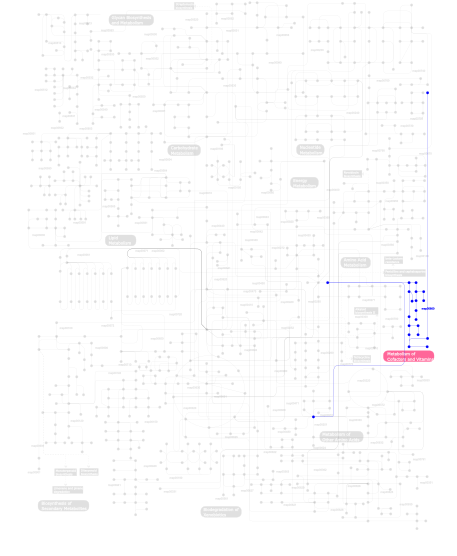
Metabolism (metabolic pathways involving proteins which contain this domain)
Click the image to view the interactive version of the map in iPath
This information is based on mapping of SMART genomic protein database to KEGG orthologous groups. Percentage points are related to the number of proteins with HTH_MERR domain which could be assigned to a KEGG orthologous group, and not all proteins containing HTH_MERR domain. Please note that proteins can be included in multiple pathways, ie. the numbers above will not always add up to 100%.