Alpha-helical motif present in Lis1, treacle, Nopp140, some katanin p60 subunits, muskelin, tonneau, LEUNIG and numerous WD40 repeat-containing proteins. It is suggested that LisH motifs contribute to the regulation of microtubule dynamics, either by mediating dimerisation, or else by binding cytoplasmic dynein heavy chain or microtubules directly.
The 33-residue LIS1 homology (LisH) motif is found in eukaryotic intracellular proteins involved in microtubule dynamics, cell migration, nucleokinesis and chromosome segregation. The LisH motif is likely to possess a conserved protein-binding function and it has been proposed that LisH motifs contribute to the regulation of microtubule dynamics, either by mediating dimerisation, or else by binding cytoplasmic dynein heavy chain or microtubules directly. The LisH motif is found associated to other domains, such as WD-40, SPRY, Kelch, AAA ATPase, RasGEF, or HEAT [ (PUBMED:11734546) (PUBMED:12384287) (PUBMED:12559565) ].
The secondary structure of the LisH domain is predicted to be two alpha- helices [ (PUBMED:11734546) ].
Regulation of cytoplasmic dynein behaviour and microtubule organization bymammalian Lis1.
Nat Cell Biol. 2000; 2: 767-75
Display abstract
Whereas total loss of Lis1 is lethal, disruption of one allele of the Lis1gene results in brain abnormalities, indicating that developing neuronsare particularly sensitive to a reduction in Lis1 dosage. Here we showthat Lis1 is enriched in neurons relative to levels in other cell types,and that Lis1 interacts with the microtubule motor cytoplasmic dynein.Production of more Lis1 in non-neuronal cells increases retrogrademovement of cytoplasmic dynein and leads to peripheral accumulation ofmicrotubules. These changes may reflect neuron-like dynein behavioursinduced by abundant Lis1. Lis1 deficiency produces the opposite phenotype.Our results indicate that abundance of Lis1 in neurons may stimulatespecific dynein functions that function in neuronal migration and axongrowth.
Kinesin and dynein superfamily proteins and the mechanism of organelle transport.
Science. 1998; 279: 519-26
Display abstract
Cells transport and sort proteins and lipids, after their synthesis, to various destinations at appropriate velocities in membranous organelles and protein complexes. Intracellular transport is thus fundamental to cellular morphogenesis and functioning. Microtubules serve as a rail on which motor proteins, such as kinesin and dynein superfamily proteins, convey their cargoes. This review focuses on the molecular mechanism of organelle transport in cells and describes kinesin and dynein superfamily proteins.
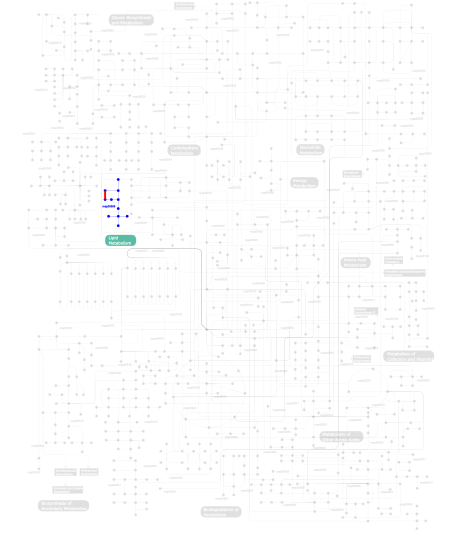
Metabolism (metabolic pathways involving proteins which contain this domain)
Click the image to view the interactive version of the map in iPath
This information is based on mapping of SMART genomic protein database to KEGG orthologous groups. Percentage points are related to the number of proteins with LisH domain which could be assigned to a KEGG orthologous group, and not all proteins containing LisH domain. Please note that proteins can be included in multiple pathways, ie. the numbers above will not always add up to 100%.