The MORN (Membrane Occupation and Recognition Nexus) motif is found in multiple copies in several proteins including junctophilins ( (PUBMED:10949023) ). The function of this motif is unknown.
Family alignment:
There are 113928 MORN domains in 17959 proteins in SMART's nrdb database.
Click on the following links for more information.
Evolution (species in which this domain is found)
Taxonomic distribution of proteins containing MORN domain.
This tree includes only several representative species. The complete taxonomic breakdown of all proteins with MORN domain is also avaliable.
Click on the protein counts, or double click on taxonomic names to display all proteins containing MORN domain in the selected taxonomic class.
Literature (relevant references for this domain)
Primary literature is listed below; Automatically-derived, secondary literature is also avaliable.
Characterization of human junctophilin subtype genes.
Biochem Biophys Res Commun. 2000; 273: 920-7
Display abstract
Junctophilin (JP) subtypes, namely JP-1, 2, and 3, have been currentlyidentified in excitable cells and constitute a novel family of junctionalmembrane complex proteins. Our studies have suggested that JPs take partin the formation of junctional membrane complexes by spanning the membraneof the intracellular Ca(2+) store and interacting with the cell-surfacemembrane. In this report we describe the primary structures, genomicorganization, and tissue distribution of human JP subtypes. By cloning andanalyzing human genomic DNA segments, the protein-coding sequenceinterrupted with four introns was defined in each JP gene. The deducedhuman JP subtypes shared characteristic structural features with theirrabbit and mouse counterparts. Genomic mapping demonstrated that JP genesdo not cluster on the human genome. RNA blot hybridization indicated thattissue-specific expression patterns of JP genes in human are essentiallythe same as those in mouse; skeletal muscle contained both JP-1 and JP-2mRNAs, the heart predominantly expressed JP-2 mRNA, and the brainspecifically contained JP-3 mRNA. In the light of this, we proposeintramolecular domains of JP subtypes based on the structural andfunctional characteristics.
Junctophilins: a novel family of junctional membrane complex proteins.
Mol Cell. 2000; 6: 11-22
Display abstract
Junctional complexes between the plasma membrane (PM) andendoplasmic/sarcoplasmic reticulum (ER/ SR) are a common feature of allexcitable cell types and mediate cross-talk between cell surface andintracellular ion channels. We have identified the junctophilins (JPs), anovel conserved family of proteins that are components of the junctionalcomplexes. JPs are composed of a carboxy-terminal hydrophobic segmentspanning the ER/SR membrane and a remaining cytoplasmic domain that showsspecific affinity for the PM. In mouse, there are at least three JPsubtypes: JP-1, -2, and -3. JP-2 is abundantly expressed in the heart, andmutant mice lacking JP-2 exhibited embryonic lethality. Cardiac myocytesfrom the mutant mice showed deficiency of the junctional membranecomplexes and abnormal Ca2+ transients. Our results suggest that JPs areimportant components of junctional membrane complexes.
Metabolism (metabolic pathways involving proteins which contain this domain)
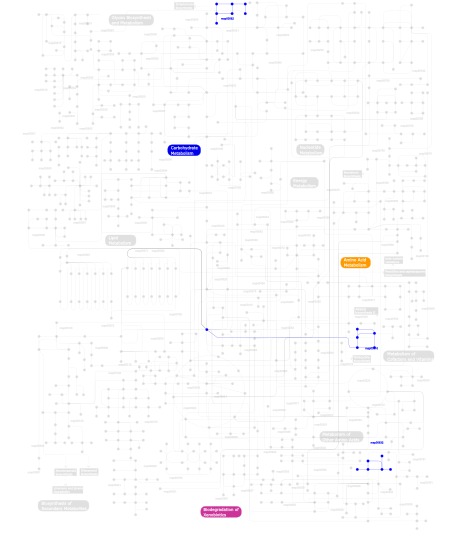
Click the image to view the interactive version of the map in iPath
This information is based on mapping of SMART genomic protein database to KEGG orthologous groups. Percentage points are related to the number of proteins with MORN domain which could be assigned to a KEGG orthologous group, and not all proteins containing MORN domain. Please note that proteins can be included in multiple pathways, ie. the numbers above will not always add up to 100%.
Links (links to other resources describing this domain)