

PGRPAnimal peptidoglycan recognition proteins homologous to Bacteriophage T3 lysozyme. |
|---|
| SMART accession number: | SM00701 |
|---|---|
| Description: | The bacteriophage molecule, but not its moth homologue, has been shown to have N-acetylmuramoyl-L-alanine amidase activity. One member of this family, Tag7, is a cytokine. |
| Interpro abstract (IPR006619): | This domain is found in a family of animal peptidoglycan recognition proteins homologous to Bacteriophage T3 lysozyme [ (PUBMED:9707603) ], and some bacterial homologues. The bacteriophage molecule, but not its moth homologue, has been shown to have N-acetylmuramoyl-L-alanine amidase activity. One member of this family, Tag7, is a cytokine [ (PUBMED:9660837) ]. |
| GO process: | peptidoglycan catabolic process (GO:0009253) |
| GO function: | N-acetylmuramoyl-L-alanine amidase activity (GO:0008745), zinc ion binding (GO:0008270) |
| Family alignment: |
There are 5568 PGRP domains in 5206 proteins in SMART's nrdb database.
Click on the following links for more information.
- Evolution (species in which this domain is found)
-
Taxonomic distribution of proteins containing PGRP domain.
This tree includes only several representative species. The complete taxonomic breakdown of all proteins with PGRP domain is also avaliable.
Click on the protein counts, or double click on taxonomic names to display all proteins containing PGRP domain in the selected taxonomic class.
- Cellular role (predicted cellular role)
-
Binding / catalysis: Peptidoglycan-binding
- Literature (relevant references for this domain)
-
Primary literature is listed below; Automatically-derived, secondary literature is also avaliable.
- Kang D, Liu G, Lundstrom A, Gelius E, Steiner H
- A peptidoglycan recognition protein in innate immunity conserved frominsects to humans.
- Proc Natl Acad Sci U S A. 1998; 95: 10078-82
- Display abstract
Innate nonself recognition must rely on common structures of invadingmicrobes. In a differential display screen for up-regulated immune genesin the moth Trichoplusia ni we have found mechanisms for recognition ofbacterial cell wall fragments. One bacteria-induced gene encodes a proteinthat, after expression in the baculovirus system, was shown to be apeptidoglycan recognition protein (PGRP). It binds strongly toGram-positive bacteria. We have also cloned the corresponding cDNA frommouse and human and shown this gene to be expressed in a variety oforgans, notably organs of the immune system-i.e., bone marrow and spleen.In addition, purified recombinant murine PGRP was shown to possesspeptidoglycan affinity. From our results and the sequence homology, weconclude that PGRP is a ubiquitous protein involved in innate immunity,conserved from insects to humans.
- Kiselev SL et al.
- Molecular cloning and characterization of the mouse tag7 gene encoding anovel cytokine.
- J Biol Chem. 1998; 273: 18633-9
- Display abstract
Cloning of the mouse tag7 gene encoding a novel cytokine is described. TheTag7 protein consists of 182 amino acids. Genomic organization of the tag7gene and its promoter region remind those of the genes of the tumornecrosis factor locus, although the tag7 gene is not linked to this locus.The gene is located on chromosome 7 at the area that corresponds to band7A3, which has genetic linkage with lupus-like disease in mouse models.tag7 transcription is essential for lymphoid organs. It is also detectedin certain areas of lungs, brain, and intestine and in some tumors. Tag7protein is detectable in both cell-associated and soluble forms. Thesoluble form of Tag7 triggers apoptosis in mouse L929 cells in vitro anddoes not involve NF-kappaB activation. The relationship between Tag7 andtumor necrosis factor family of ligands is discussed.
- Metabolism (metabolic pathways involving proteins which contain this domain)
-
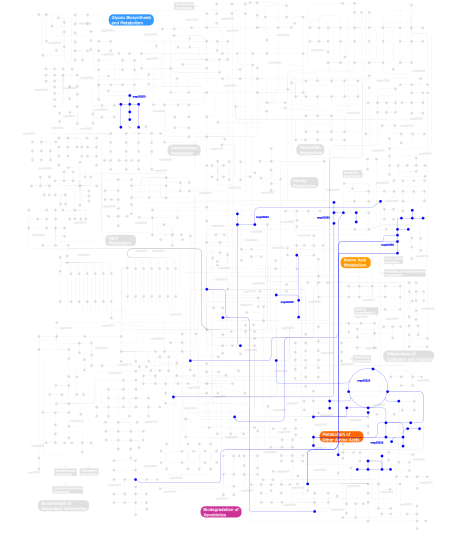
Click the image to view the interactive version of the map in iPath% proteins involved KEGG pathway ID Description 70.00  map00550
Peptidoglycan biosynthesis 5.00 map00380Tryptophan metabolism 5.00 map00220Urea cycle and metabolism of amino groups 5.00 map00643Styrene degradation 5.00 map00460Cyanoamino acid metabolism 5.00 map00360Phenylalanine metabolism 5.00 map00632Benzoate degradation via CoA ligation This information is based on mapping of SMART genomic protein database to KEGG orthologous groups. Percentage points are related to the number of proteins with PGRP domain which could be assigned to a KEGG orthologous group, and not all proteins containing PGRP domain. Please note that proteins can be included in multiple pathways, ie. the numbers above will not always add up to 100%.
- Structure (3D structures containing this domain)
3D Structures of PGRP domains in PDB
PDB code Main view Title 1aro 
T7 RNA POLYMERASE COMPLEXED WITH T7 LYSOZYME 1lba 
THE STRUCTURE OF BACTERIOPHAGE T7 LYSOZYME, A ZINC AMIDASE AND AN INHIBITOR OF T7 RNA POLYMERASE 1oht 
Peptidoglycan recognition protein LB 1s2j 
Crystal structure of the Drosophila pattern-recognition receptor PGRP-SA 1sk3 
Crystal structure of the C-terminal peptidoglycan-binding domain of human peptidoglycan recognition protein Ialpha 1sk4 
crystal structure of the C-terminal peptidoglycan-binding domain of human peptidoglycan recognition protein Ialpha 1sxr 
Drosophila Peptidoglycan Recognition Protein (PGRP)-SA 1twq 
Crystal structure of the C-terminal PGN-binding domain of human PGRP-Ialpha in complex with PGN analog muramyl tripeptide 1yck 
Crystal structure of human peptidoglycan recognition protein (PGRP-S) 1z6i 
Crystal structure of the ectodomain of Drosophila transmembrane receptor PGRP-LCa 2aph 
Crystal structure of human PGRP-IalphaC in complex with muramyl pentapeptide 2cb3 
Crystal structure of peptidoglycan recognition protein-LE in complex with tracheal cytotoxin (monomeric diaminopimelic acid-type peptidoglycan) 2eav 
Crystal structure of the C-terminal peptidoglycan-binding domain of human peptidoglycan recognition protein Ibeta 2eax 
Crystal structure of human PGRP-IBETAC in complex with glycosamyl muramyl pentapeptide 2f2l 
Crystal structure of tracheal cytotoxin (TCT) bound to the ectodomain complex of peptidoglycan recognition proteins LCa (PGRP-LCa) and LCx (PGRP-LCx) 2r2k 
Crystal structure of the complex of camel peptidoglycan recognition protein with disaccharide at 3.2A resolution 2r90 
Crystal structure of cameline peptidoglycan recognition protein at 2.8A resolution 2rkq 
Crystal structure of drosophila peptidoglycan recognition protein SD (PGRP-SD) 2xz4 
Crystal structure of the LFZ ectodomain of the peptidoglycan recognition protein LF 2xz8 
CRYSTAL STRUCTURE OF THE LFW ECTODOMAIN OF THE PEPTIDOGLYCAN RECOGNITION PROTEIN LF 2z9n 
Crystal structure of cameline peptidoglycan recognition protein at 3.2 A resolution 3c2x 
Crystal structure of peptidoglycan recognition protein at 1.8A resolution 3cg9 
Crystal structure of the complex of peptidoglycan recognition protein with methyloxane-2,3,4,5-tetrol at 2.9 A resolution 3cor 
Crystal structure of the complex of peptidoglycan recognition protein (PGRP-S) with N-acetylgalactosamine at 3.1 A resolution 3cxa 
Crystal structure of the complex of peptidoglycan recognition protein with alpha-D-glucopyranosyl alpha-D-glucopyranoside at 3.4 A resolution 3ep1 
Structure of the PGRP-Hd from Alvinella pompejana 3ng4 
Ternary complex of peptidoglycan recognition protein (PGRP-S) with Maltose and N-Acetylglucosamine at 1.7 A Resolution 3nno 
Crystal structure of the complex of peptidoglycan recognition protein (PGRP-S) with Alpha-Rhamnose at 2.9 A resolution 3nw3 
Crystal structure of the complex of peptidoglycan recognition protein (PGRP-S) with the PGN Fragment at 2.5 A resolution 3o4k 
Crystal structure of the complex of peptidoglycan recognition protein (PGRP-S) and lipoteichoic acid at 2.1 A resolution 3ogx 
Crystal structure of the complex of Peptidoglycan Recognition protein (PGRP-s) with Heparin-Dissacharide at 2.8 A resolution 3qj1 
Crystal structure of camel peptidoglycan recognition protein, PGRP-S with a trapped diethylene glycol in the ligand diffusion channel at 3.2 A resolution 3qs0 
Crystal structure of the complex of peptidoglycan recognition protein (PGRP-S) with a bound N-acetylglucosamine in the diffusion channel at 2.5 A resolution 3qv4 
Crystal structure of the complex of peptidoglycan recognition protein (PGRP-S) with dipeptide L-ALA D-GLU at 2.7 A resolution 3rt4 
Structural Basis of Recognition of Pathogen-associated Molecular Patterns and Inhibition of Proinflammatory Cytokines by Camel Peptidoglycan Recognition Protein 3t2v 
Crystal structure of the complex of peptidoglycan recognition protein-short (CPGRP-S) with mycolic acid at 2.5 A resolution 3t39 
Crystal structure of the complex of camel peptidoglycan recognition protein(CPGRP-S) with a mycobacterium metabolite shikimate at 2.7 A resolution 3tru 
Crystal structure of the complex of peptidoglycan recognition protein with cellular metabolite chorismate at 3.2 A resolution 3uil 
Crystal Structure of the complex of PGRP-S with lauric acid at 2.2 A resolution 3uml 
Crystal structure of PGRP-S complexed with chorismate at 2.15 A resolution 3umq 
Crystal structure of peptidoglycan recognition protein-S complexed with butyric acid at 2.2 A resolution 3usx 
Crystal structure of PGRP-S complexed with Myristic Acid at 2.28 A resolution 4fnn 
Crystal structure of the complex of CPGRP-S with stearic acid at 2.2 A RESOLUTION 4gf9 
Structural insights into the dual strategy of recognition of peptidoglycan recognition protein, PGRP-S: ternary complex of PGRP-S with LPS and fatty acid 4opp 
Crystal structure of the ternary complex of camel peptidoglycan recognition protein PGRP-S with 11-cyclohexylundecanoic acid and N- acetylglucosamine at 2.30 A resolution 4orv 
Crystal structure of the ternary complex of camel peptidoglycan recognition protein PGRP-S with 7- phenylheptanoic acid and N- acetylglucosamine at 2.50 A resolution 4oug 
Crystal structure of the ternary complex of camel peptidoglycan recognition protein, PGRP-S with lipopolysaccharide and palmitic acid at 2.46 A resolution 4q8s 
Crystal structure of mammalian Peptidoglycan recognition protein PGRP-S with paranitrophenyl palmitate and N-acetyl glucosamine at 2.09 A resolution 4q9e 
Structure of the ternary complex of peptidoglycan recognition protein, PGRP-S with N-acetyl glucosamine and paranitro benzaldehyde at 2.3 A resolution 4z8i 
4Z8I 4zxm 
4ZXM 5dwf 
5DWF 5e0a 
5E0A 5e0b 
5E0B - Links (links to other resources describing this domain)
-
INTERPRO IPR006619