Cadherin-homologous domains present in metazoan dystroglycans and alpha/epsilon sarcoglycans, yeast Axl2p and in a very large protein from magnetotactic bacteria. Likely to bind calcium ions.
In animals, cadherin domain-containing proteins are adhesion molecules that modulate a wide variety of processes including cell polarization and migration but they have also been identified in yeast and magnetotactic bacteria. Crystal structures have revealed that multiple cadherin domains form Ca 2+ -dependent rod-like structures with a conserved Ca 2+ -binding pocket at the domain-domain interface [ (PUBMED:11909544) ].
Selection of axial growth sites in yeast requires Axl2p, a novel plasma membrane glycoprotein.
Genes Dev. 1996; 10: 777-93
Display abstract
Spa2p and Cdc10p both participate in bud site selection and cell morphogenesis in yeast, and spa2delta cdc10-10 cells are inviable. To identify additional components important for these processes in yeast, a colony-sectoring assay was used to isolate high-copy suppressors of the spa2delda cdc10-10 lethality. One such gene, AXL2, has been characterized in detail. axl2 cells are defective in bud site selection in haploid cells and bud in a bipolar fashion. Genetic analysis indicates that AXL2 falls into the same epistasis group as BUD3. Axl2p is predicted to be a type I transmembrane protein. Tunicamycin treatment experiments, biochemical fractionation and extraction experiments, and proteinase K protection experiments collectively indicate that Axl2p is an integral membrane glycoprotein at the plasma membrane. Indirect immunofluorescence experiments using either Axl2p tagged with three copies of a hemagglutinin epitope or high-copy AXL2 and anti-Axl2p antibodies reveal a unique localization pattern for Axl2p. The protein is present as a patch at the incipient bud site and in emerging buds, and at the bud periphery in small-budded cells. In cells containing medium-sized or large buds, Axl2p is located as a ring at the neck. Thus, Axl2p is a novel membrane protein critical for selecting proper growth sites in yeast. We suggest that Axl2p acts as an anchor in the plasma membrane that helps direct new growth components and/or polarity establishment components to the cortical axial budding site.
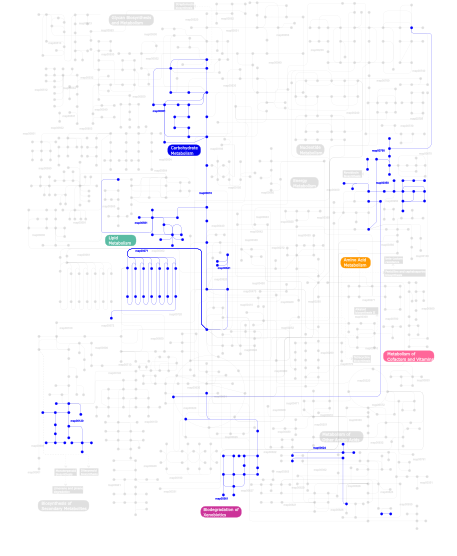
Metabolism (metabolic pathways involving proteins which contain this domain)
Click the image to view the interactive version of the map in iPath
This information is based on mapping of SMART genomic protein database to KEGG orthologous groups. Percentage points are related to the number of proteins with CADG domain which could be assigned to a KEGG orthologous group, and not all proteins containing CADG domain. Please note that proteins can be included in multiple pathways, ie. the numbers above will not always add up to 100%.