Diacylglycerol (DAG) is a second messenger that acts as a protein kinase C activator. DAG can be produced from the hydrolysis of phosphatidylinositol 4,5-bisphosphate (PIP2) by a phosphoinositide-specific phospholipase C and by the degradation of phosphatidylcholine (PC) by a phospholipase C or the concerted actions of phospholipase D and phosphatidate phosphohydrolase. This domain is presumed to be the catalytic domain. Bacterial homologues areknown.
The DAG-kinase catalytic domain or DAGKc domain is present in mammalian lipid kinases, such as diacylglycerol (DAG), ceramide and sphingosine kinases, as well as in related bacterial proteins [ (PUBMED:8626538) (PUBMED:17351295) ]. Eukaryotic DAG-kinase ( EC 2.7.1.107 ) catalyses the phosphorylation of DAG to phosphatidic acid, thus modulating the balance between the two signaling lipids. At least ten different isoforms have been identified in mammals, which form 5 groups characterised by different functional domains, such as the calcium-binding EF hand PH SAM DAG/PE-binding C1 domain and ankyrin repeats [ (PUBMED:17512245) ].
In bacteria, an integral membrane DAG kinase forms a homotrimeric protein that lacks the DAGKc domain. In contrast, the bacterial yegS protein is a soluble cytosolic protein that contains the DAGKc domain in the N-terminal part. YegS is a lipid kinase with two structural domains, wherein the active site is located in the interdomain cleft, C-terminal to the DAGKc domain which forms an alpha/beta fold [ (PUBMED:17351295) ]. The tertiary structure resembles that of NAD kinases and contains a metal-binding site in the C-terminal region [ (PUBMED:17351295) (PUBMED:19112175) ].
This domain is usually associated with an accessory domain (see IPR000756 ).
SMART, a simple modular architecture research tool: identification of signaling domains.
Proc Natl Acad Sci U S A. 1998; 95: 5857-64
Display abstract
Accurate multiple alignments of 86 domains that occur in signaling proteins have been constructed and used to provide a Web-based tool (SMART: simple modular architecture research tool) that allows rapid identification and annotation of signaling domain sequences. The majority of signaling proteins are multidomain in character with a considerable variety of domain combinations known. Comparison with established databases showed that 25% of our domain set could not be deduced from SwissProt and 41% could not be annotated by Pfam. SMART is able to determine the modular architectures of single sequences or genomes; application to the entire yeast genome revealed that at least 6.7% of its genes contain one or more signaling domains, approximately 350 greater than previously annotated. The process of constructing SMART predicted (i) novel domain homologues in unexpected locations such as band 4.1-homologous domains in focal adhesion kinases; (ii) previously unknown domain families, including a citron-homology domain; (iii) putative functions of domain families after identification of additional family members, for example, a ubiquitin-binding role for ubiquitin-associated domains (UBA); (iv) cellular roles for proteins, such predicted DEATH domains in netrin receptors further implicating these molecules in axonal guidance; (v) signaling domains in known disease genes such as SPRY domains in both marenostrin/pyrin and Midline 1; (vi) domains in unexpected phylogenetic contexts such as diacylglycerol kinase homologues in yeast and bacteria; and (vii) likely protein misclassifications exemplified by a predicted pleckstrin homology domain in a Candida albicans protein, previously described as an integrin.
Recent observations suggest that diacylglycerol kinase (DGK) is one of the key enzymes involved in the regulation of signal transduction. It attenuates protein kinase C activity and cell cycle progression of T-lymphocytes, through controlling the intracellular levels of the second messengers, diacylglycerol and phosphatidic acid. To date, eight DGK isozymes containing characteristic zinc finger structures in common have been identified. Type I DGKs (alpha, beta and gamma) contain EF-hand motifs that contribute to the calcium-dependent activities of this type of DGK. A pleckstrin homology and/or an EPH C-terminal tail homology domains are found in type II isozymes (DGK delta and eta). DGK epsilon represents a third type of DGK that selectively phosphorylates arachidonate-containing diacylglycerol. DGK zeta (type IV) and DGK theta (type V) contain four tandem ankyrin repeats and a Ras-associating domain, respectively.
Molecular cloning of a novel diacylglycerol kinase isozyme with a pleckstrin homology domain and a C-terminal tail similar to those of the EPH family of protein-tyrosine kinases.
J Biol Chem. 1996; 271: 8394-401
Display abstract
A fourth member of the diacylglycerol kinase (DGK) gene family termed DGK delta was cloned from the human testis cDNA library. The cDNA sequence contains an open reading frame of 3,507 nucleotides encoding a putative DGK protein of 130,006 Da. Interestingly, the new DGK isozyme contains a pleckstrin homology domain found in a number of proteins involved in signal transduction. Furthermore, the C-terminal tail of this isozyme is very similar to those of the EPH family of receptor tyrosine kinases. The primary structure of the delta-isozyme also has two cysteine-rich zinc finger-like structures (C3 region) and the C-terminal C4 region, both of which have been commonly found in the three isozymes previously cloned (DGKs alpha, beta and gamma). However, DGK delta lacks the EF-hand motifs (C2) and contains a long Glu- and Ser-rich insertion (317 residues), which divides the C4 region into two portions. Taken together, these structural features of DGK delta indicate that this isozyme belongs to a DGK subfamily distinct from that consisting of DGKs alpha, beta, and gamma. Increased DGK activity without marked preference to arachidonoyl type of diacylglycerol was detected in the particulate fraction of COS-7 cells expressing the transfected DGKdelta cDNA. The enzyme activity was independent of phosphatidylserine, which is a common activator for the previously sequenced DGKs. Northern blot analysis showed that the DGK delta mRNA (approximately 6.3 kilobases) is most abundant in human skeletal muscle but undetectable in the brain, thymus, and retina. This expression pattern is different from those of the previously cloned DGKs. Our results show that the DGK gene family consists of at least two subfamilies consisting of enzymes with distinct structural characteristics and that each cell type probably expresses its own characteristic repertoire of DGKs whose functions may be regulated through different signal transduction pathways.
Molecular cloning of a novel human diacylglycerol kinase highly selective for arachidonate-containing substrates.
J Biol Chem. 1996; 271: 10237-41
Display abstract
Diacylglycerol (DAG) is a second messenger that activates protein kinase C and also occupies a central role in phospholipid biosynthesis. Conversion of DAG to phosphatidic acid by DAG kinase regulates the amount of DAG and the route it takes. We used degenerate primers to amplify polymerase chain reaction products from cDNA derived from human endothelial cells. A product with a novel sequence was identified and used to clone a 2.6-kilobase cDNA from an endothelial cell library. When transfected with a truncated version of this cDNA, COS-7 cells had a marked increase in DAG kinase activity, which demonstrated clear selectivity for arachidonoyl-containing species of diacylglycerol. The open reading frame of this clone has 567 residues with a predicted protein of 64 kDa. This enzyme, which we designated DGK epsilon, has two distinctive zinc finger-like structures in its N-terminal region, but does not contain the E-F hand motifs found in several other mammalian DGKs. The catalytic domain of DGK epsilon, which is related to other DGKs, contains two ATP-binding motifs. Northern blotting demonstrated that DGK epsilon is expressed predominantly in testis. This unique diacylglycerol kinase may terminate signals transmitted through arachidonoyl-DAG or may contribute to the synthesis of phospholipids with defined fatty acid composition.
Diacylglycerol kinase: a key modulator of signal transduction?
Trends Biochem Sci. 1990; 15: 47-50
Display abstract
Diacylglycerol kinase (DGK) plays a central role in the metabolism of diacylglycerol released as a second messenger in agonist-stimulated cells. The major purified form of the enzyme (80 kDa DGK) is highly abundant in lymphocyte cytosol and may become membrane-associated via phosphorylation by protein kinase C. In addition, there are several kinase subspecies immunologically distinct from the 80 kDa enzyme, which differ markedly in their responses to several compounds such as sphingosine and R59022. Thus, further work on each enzyme species is needed to define the function of DGK in stimulated cells.
Porcine diacylglycerol kinase sequence has zinc finger and E-F hand motifs.
Nature. 1990; 344: 345-8
Display abstract
Cell stimulation causes diacylglycerol kinase (DGK) to convert the second messenger diacylglycerol into phosphatidate, thus initiating the resynthesis of phosphatidylinositols and attenuating protein kinase C activity. Of the DGK isoforms so far reported, only porcine DGK from lymphocytes has been characterized in detail. Here we report the isolation and sequencing of complementary DNA clones that together cover the entire region encoding porcine DGK (relative molecular mass 80,000 (80K)). The deduced primary structure of this DGK contains the putative ATP-binding sites, two cysteine-rich zinc finger-like sequences similar to those found in protein kinase C, and two E-F hand motifs, typical of Ca2(+)-binding proteins like calmodulin. Indeed, we find that the activity of this DGK isoform is enhanced by micromolar concentrations of Ca2+ in the presence of deoxycholate or sphingosine. These properties of 80K DGK indicate that its action is probably linked with both of the second messengers diacylglycerol and inositol 1,4,5-trisphosphate.
Purification, cDNA-cloning and expression of human diacylglycerol kinase.
FEBS Lett. 1990; 275: 151-8
Display abstract
Diacylglycerol (DG) kinase attenuates the level of the second messenger DG in signal transduction, and therefore possibly modulates protein kinase C (PKC). DG kinase was purified to homogeneity from human white blood cells, showing an Mr of 86 kDa as determined by SDS-PAGE and gel filtration. Two amino acid sequences of tryptic peptides from DG kinase were determined and degenerate oligonucleotides were prepared and used in the polymerase chain reaction. An amplified DNA fragment was subsequently used to clone the full-length human DG kinase cDNA. This sequence is the human homolog of a porcine DG kinase cDNA sequence reported recently. The sequence contains a double EF-hand structure typical for Ca2+ binding proteins. DG kinase further contains a double cysteine repeat that is present in all PKC isoforms, where it constitutes the phorbol ester (and most likely diacylglycerol) binding site. Therefore we speculate that the double cysteine repeat in DG kinase is involved in DG binding. DG kinase is transcribed as a single mRNA of 3.2 kb, that is highly expressed in T-lymphocytes. The human DG kinase cDNA when transfected in mammalian cells (COS-7) results in a 6-7-fold increase of DG kinase activity.
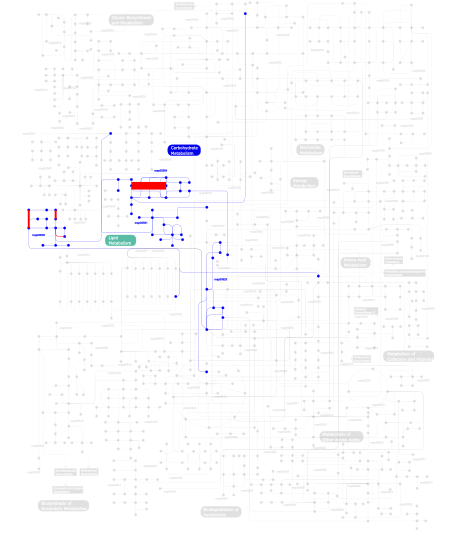
Metabolism (metabolic pathways involving proteins which contain this domain)
Click the image to view the interactive version of the map in iPath
This information is based on mapping of SMART genomic protein database to KEGG orthologous groups. Percentage points are related to the number of proteins with DAGKc domain which could be assigned to a KEGG orthologous group, and not all proteins containing DAGKc domain. Please note that proteins can be included in multiple pathways, ie. the numbers above will not always add up to 100%.