
| SMART accession number: | SM00333
|
|---|
| Description: |
Domain of unknown function present in several RNA-binding proteins. 10 copies in the Drosophila Tudor protein. Initial proposal that the survival motor neuron gene product contain a Tudor domain are corroborated by more recent database search techniques such as PSI-BLAST (unpublished). |
| Interpro abstract (IPR002999): |
The drosophila tudor protein is encoded by a 'posterior group' gene, which when mutated disrupt normal abdominal segmentation and pole cell formation. Another drosophila gene, homeless, is required for RNA localization during oogenesis. The tudor protein contains multiple repeats of a domain which is also found in homeless [(PUBMED:9048482)]. The tudor domain is found in many proteins that colocalise with ribonucleoprotein or single-strand DNA-associated complexes in the nucleus, in the mitochondrial membrane, or at kinetochores. It is not known whether the domain binds directly to RNA and ssDNA, or controls interactions with the nucleoprotein complexes. At least one tudor-containing protein, homeless, also contains a zinc finger typical of RNA-binding proteins [(PUBMED:9048482)]. The resolution of the solution structure of the Tudor domain of human SMN revealed that the Tudor domain forms a strongly bent antiparallel beta-sheet with five strands forming a barrel-like fold. The structure exhibits a conserved negatively charged surface that interacts with the C-terminal Arg and Gly-rich tails of the spliceosomal Sm D1 and D3 proteins [(PUBMED:11135666)].
|
| Family alignment: |
|
|---|
Click on the following links for more information.
- Evolution (species in which this domain is found)
-
- Literature (relevant references for this domain)
-
Primary literature is listed below; Automatically-derived, secondary literature is also avaliable.
- Talbot K, Miguel-Aliaga I, Mohaghegh P, Ponting CP, Davies KE
- Characterization of a gene encoding survival motor neuron (SMN)-related protein, a constituent of the spliceosome complex.
- Hum Mol Genet. 1998; 7: 2149-56
- Display abstract
Mutations in the gene encoding the Survival Motor Neuron (SMN) protein are responsible for autosomal recessive proximal spinal muscular atrophy (SMA). SMN orthologues have been identified in the nematode worm Caenorhabditis elegans and the yeast Schizosaccharomyces pombe but, to date, no human paralogues have been described. Here we describe identification and characterization of an SMN-related protein (SMNrp) gene that encodes a novel protein of 239 amino acids, which has recently been identified as a constituent of the spliceosome complex and designated SPF30. Significant similarity to the SMN protein is apparent only within a central region of SMNrp that represents a tudor domain. The SMNrp/SPF30 gene has been mapped to chromosome 10q23. It is differentially expressed, with abundant levels in skeletal muscle. An exclusively nuclear localization for SMNrp in cultured cells and muscle sections was revealed using GFP fusion constructs and thereafter confirmed with a polyclonal antibody raised against SMNrp. Overexpression of SMNrp as a fusion protein in HeLa cells in culture induced dose-dependent apoptosis with positive TUNEL staining. In addition to a possible role for this protein as a pro-apoptotic factor, SMN and its related protein share significant similarities in sequence and cellular function.
- Mushegian AR, BassettDEJ r, Boguski MS, Bork P, Koonin EV
- Positionally cloned human disease genes: patterns of evolutionary conservation and functional motifs.
- Proc Natl Acad Sci U S A. 1997; 94: 5831-6
- Display abstract
Positional cloning has already produced the sequences of more than 70 human genes associated with specific diseases. In addition to their medical importance, these genes are of interest as a set of human genes isolated solely on the basis of the phenotypic effect of the respective mutations. We analyzed the protein sequences encoded by the positionally cloned disease genes using an iterative strategy combining several sensitive computer methods. Comparisons to complete sequence databases and to separate databases of nematode, yeast, and bacterial proteins showed that for most of the disease gene products, statistically significant sequence similarities are detectable in each of the model organisms. Only the nematode genome encodes apparent orthologs with conserved domain architecture for the majority of the disease genes. In yeast and bacterial homologs, domain organization is typically not conserved, and sequence similarity is limited to individual domains. Generally, human genes complement mutations only in orthologous yeast genes. Most of the positionally cloned genes encode large proteins with several globular and nonglobular domains, the functions of some or all of which are not known. We detected conserved domains and motifs not described previously in a number of proteins encoded by disease genes and predicted functions for some of them. These predictions include an ATP-binding domain in the product of hereditary nonpolyposis colon cancer gene (a MutL homolog), which is conserved in the HS90 family of chaperone proteins, type II DNA topoisomerases, and histidine kinases, and a nuclease domain homologous to bacterial RNase D and the 3'-5' exonuclease domain of DNA polymerase I in the Werner syndrome gene product.
- Ponting CP
- Tudor domains in proteins that interact with RNA.
- Trends Biochem Sci. 1997; 22: 51-2
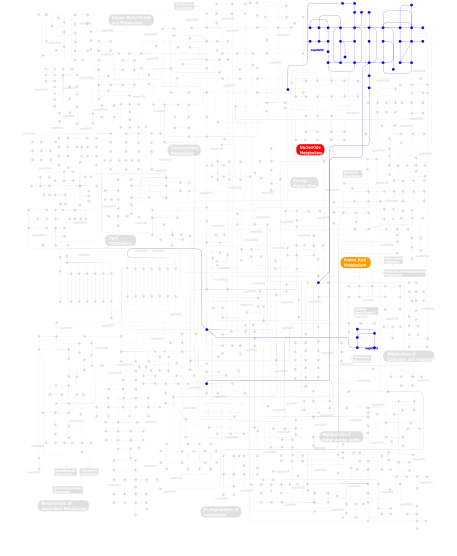
- Metabolism (metabolic pathways involving proteins which contain this domain)
-
- Structure (3D structures containing this domain)
3D Structures of TUDOR domains in PDB
| PDB code | Main view | Title | | 1g5v |  | Solution structure of the tudor domain of the human smn protein |
| 1mhn |  | High resolution crystal structure of the smn tudor domain |
| 2d9t |  | Solution structure of the tudor domain of tudor domain containing protein 3 from mouse |
| 2dig |  | Solusion structure of the todor domain of human lamin-b receptor |
| 2diq |  | Solution structure of the tudor domain of tudor and kh domain containing protein |
| 2e5p |  | Solution structure of the tudor domain of phd finger protein 1 (phf1 protein) |
| 2e5q |  | Solution structure of the tudor domain of phd finger protein 19, isoform b [homo sapiens] |
| 2e6n |  | Solution structure of the tudor domain of staphylococcal nuclease domain-containing protein 1 |
| 2eqj |  | Solution structure of the tudor domain of metal-response element-binding transcription factor 2 |
| 2eqk |  | Solution structure of the tudor domain of tudor domain- containing protein 4 |
| 2equ |  | Solution structure of the tudor domain of phd finger protein 20-like 1 |
| 2gf7 |  | Double tudor domain structure |
| 2gfa |  | Double tudor domain complex structure |
| 2hqe |  | Crystal structure of human p100 tudor domain: large fragment |
| 2hqx |  | Crystal structure of human p100 tudor domain conserved region |
| 2o4x |  | Crystal structure of human p100 tudor domain |
| 2qqr |  | Jmjd2a hybrid tudor domains |
| 2qqs |  | Jmjd2a tandem tudor domains in complex with a trimethylated histone h4-k20 peptide |
| 2wac |  | Extended tudor domain of drosophila melanogaster tudor-sn ( p100) |
| 3bdl |  | Crystal structure of a truncated human tudor-sn |
| 3dlm |  | Crystal structure of tudor domain of human histone-lysine n- methyltransferase setdb1 |
| 3fdr |  | Crystal structure of tdrd2 |
- Links (links to other resources describing this domain)
-