The domain within your query sequence starts at position and ends at position ; the E-value for the CUE domain shown below is < 1e-12.
dummy
CUE
Domain that may be involved in binding ubiquitin-conjugating enzymes (UBCs)
SMART accession number:
SM00546
Description:
CUE domains also occur in two protein of the IL-1 signal transduction pathway, tollip and TAB2. Ponting (Biochem. J.) "Proteins of the Endoplasmic reticulum" (in press)
This domain promotes intramolecular monoubiquitination and has a dual role in mono- and poly-ubiquitination recognition, being involved in binding ubiquitin-conjugating enzymes (UBCs) [ (PUBMED:12573224) (PUBMED:12628920) (PUBMED:23665229) ]. CUE domains also occur in two proteins of the IL-1 signal transduction pathway, tollip and TAB2.
Role of Cue1p in ubiquitination and degradation at the ER surface.
Science. 1997; 278: 1806-9
Display abstract
Endoplasmic reticulum (ER) degradation of aberrant proteins is mediated by the ubiquitin-proteasome pathway. Here, a membrane-bound component of the ubiquitin system, Cue1p, was identified. It was shown to recruit the soluble ubiquitin-conjugating enzyme Ubc7p to the ER membrane. In the absence of Cue1p, unassembled and thus cytosolically mislocalized Ubc7p was unable to participate in ER degradation or in the turnover of soluble non-ER proteins. Moreover, ubiquitination by Cue1p-assembled Ubc7p and Ubc6p was a prerequisite for retrograde transport of lumenal substrates out of the ER, which suggests that ubiquitination is mechanistically integrated into the ER degradation process.
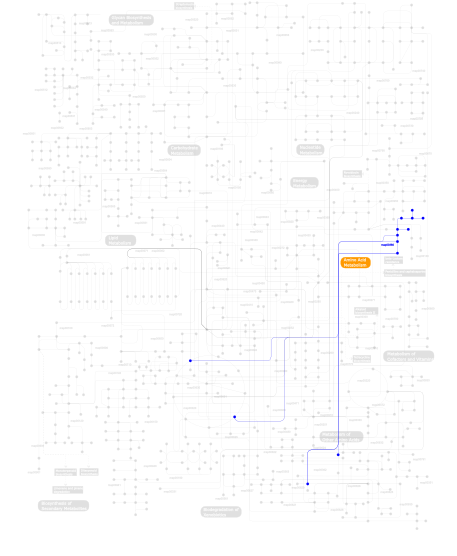
Metabolism (metabolic pathways involving proteins which contain this domain)
Click the image to view the interactive version of the map in iPath
This information is based on mapping of SMART genomic protein database to KEGG orthologous groups. Percentage points are related to the number of proteins with CUE domain which could be assigned to a KEGG orthologous group, and not all proteins containing CUE domain. Please note that proteins can be included in multiple pathways, ie. the numbers above will not always add up to 100%.