

The domain within your query sequence starts at position and ends at position ; the E-value for the UBCc domain shown below is < 1e-12.
WARNING!
Some of the required catalytic sites were not detected in this domain. It is probably inactive! Check the literature (PubMed 97407928 ) for details.
| Catalytic residues | |||
|---|---|---|---|
| Position | Amino acid | Present? | |
| Domain | Protein | ||
| N/A | N/A | C | No |
DUMMY
UBCcUbiquitin-conjugating enzyme E2, catalytic domain homologues |
|---|
| SMART accession number: | SM00212 |
|---|---|
| Description: | Proteins destined for proteasome-mediated degradation may be ubiquitinated. Ubiquitination follows conjugation of ubiquitin to a conserved cysteine residue of UBC homologues. This pathway functions in regulating many fundamental processes required for cell viability.TSG101 is one of several UBC homologues that lacks this active site cysteine. |
| Family alignment: |
There are 43578 UBCc domains in 43296 proteins in SMART's nrdb database.
Click on the following links for more information.
- Evolution (species in which this domain is found)
-
Taxonomic distribution of proteins containing UBCc domain.
This tree includes only several representative species. The complete taxonomic breakdown of all proteins with UBCc domain is also avaliable.
Click on the protein counts, or double click on taxonomic names to display all proteins containing UBCc domain in the selected taxonomic class.
- Cellular role (predicted cellular role)
-
Binding / catalysis: protein-binding, ubiquitin-conjugating
- Literature (relevant references for this domain)
-
Primary literature is listed below; Automatically-derived, secondary literature is also avaliable.
- Cook WJ, Martin PD, Edwards BF, Yamazaki RK, Chau V
- Crystal structure of a class I ubiquitin conjugating enzyme (Ubc7) from Saccharomyces cerevisiae at 2.9 angstroms resolution.
- Biochemistry. 1997; 36: 1621-7
- Display abstract
Ubiquitin-conjugating enzymes are a family of related proteins that participate in the ubiquitination of proteins. Previous studies on the crystal structures of Saccharomyces cerevisiae Ubc4 and Arabidopsis thaliana Ubc1 indicated that the smallest enzymes (class I), which consist entirely of the conserved core domain, share a common tertiary fold. Here we report the three-dimensional structure of the S. cerevisiae class I enzyme encoded by the UBC7 gene. The crystal structure has been solved using molecular replacement techniques and refined by simulated annealing to an R-factor of 0.183 at 2.93 A resolution. Bond lengths and angles in the molecule have root-mean-square deviations from ideal values of 0.016 A and 2.3 degrees, respectively. Ubc7 is an alpha/beta protein with four alpha-helices and a four-stranded antiparallel beta-sheet. With the exception of two regions where extra residues are present, the tertiary folding of Ubc7 is similar to those of the other two enzymes. The ubiquitin-accepting cysteine is located in a cleft between two loops. One of these loops is nonconserved, as this region of the Ubc7 molecule differs from the other two enzymes by having 13 extra residues. There is also a second single amino acid insertion that alters the orientation of the turn between the first two beta-strands. Analysis of the 13 ubiquitin-conjugating enzyme sequences in S. cerevisiae indicates that there may be two other regions where extra residues could be inserted into the common tertiary fold. Both of these other regions exhibit significant deviations in the superposition of the three structures and, like the two insertion regions in Ubc7, may represent hypervariable regions within a common tertiary fold. As ubiquitin-conjugating enzymes interact with different substrates or other accessory proteins in the ubiquitination pathway, these variable surface regions may confer distinct specificity to individual enzymes.
- Hatakeyama S, Jensen JP, Weissman AM
- Subcellular localization and ubiquitin-conjugating enzyme (E2) interactions of mammalian HECT family ubiquitin protein ligases.
- J Biol Chem. 1997; 272: 15085-92
- Display abstract
In most instances, the transfer of ubiquitin to target proteins is catalyzed by the action of ubiquitin protein ligases (E3s). Full-length cDNAs encoding murine E6-associated protein (mE6-AP) as well as Nedd-4, a protein that is homologous to E6-AP in its C terminus, were cloned. Nedd-4 and mouse E6-AP are both enzymatically active E3s and function with members of the UbcH5 family of E2s. Mouse E6-AP, like its human counterpart, ubiquitinates p53 in the presence of human papilloma virus E6 protein, while Nedd-4 does not. Consistent with its role in p53 ubiquitination, mE6-AP was found both in the nucleus and cytosol, while Nedd-4 was found only in the cytosol. Binding studies implicate a 150-amino acid region that is 40% identical between mE6-AP and Nedd-4 as a binding site for the C-terminal portion of an E2 enzyme (UbcH5B). Nedd-4 was determined to have a second nonoverlapping E2 binding site that recognizes the first 67 amino acids of UbcH5B but not the more C-terminal portion of this E2. These findings provide the first demonstration of physical interactions between mammalian E2s and E3s and establish that these interactions occur independently of ubiquitin and an intact E3 catalytic domain. Furthermore, the presence of two E2 binding sites within Nedd-4 suggests models for ubiquitination involving multiple E2 enzymes associated with E3s.
- Koonin EV, Abagyan RA
- TSG101 may be the prototype of a class of dominant negative ubiquitin regulators.
- Nat Genet. 1997; 16: 330-1
- Kumar S, Kao WH, Howley PM
- Physical interaction between specific E2 and Hect E3 enzymes determines functional cooperativity.
- J Biol Chem. 1997; 272: 13548-54
- Display abstract
The cellular protein E6AP functions as an E3 ubiquitin protein ligase in the E6-dependent ubiquitination of p53. E6AP is a member of a family of functionally related E3 proteins that share a conserved carboxyl-terminal region called the Hect domain. Although several different E2 ubiquitin-conjugating enzymes have been shown to function with E6AP in the E6-dependent ubiquitination of p53 in vitro, the E2s that cooperate with E6AP in the ubiquitination of its normal substrates are presently unknown. Moreover, the basis of functional cooperativity between specific E2 and Hect E3 proteins has not yet been determined. Here we report the cloning of a new human E2, designated UbcH8, that was identified in a two-hybrid screen through specific interaction with E6AP. We demonstrate that UbcH7, an E2 closely related to UbcH8, can also bind to E6AP. The region of E6AP involved in complex formation with UbcH8 and UbcH7 was mapped to its Hect domain. Furthermore, we show that UbcH5 and UbcH6, two highly homologous E2s that were deficient for interaction with E6AP, could associate efficiently with another Hect-E3 protein, RSP5. Finally, only the E6AP-interacting E2s could function in conjunction with E6AP in the ubiquitination of an E6 independent substrate of E6AP, whereas the noninteracting E2s could not. Taken together, these studies demonstrate for the first time complex formation between specific human E2s and the Hect domain family of E3 proteins and suggest that selective physical interaction between E2 and E3 enzymes forms the basis of specificity for functionally distinct E2:E3 combinations.
- Ponting CP, Aravind L
- PAS: a multifunctional domain family comes to light.
- Curr Biol. 1997; 7: 6747-6747
- Ponting CP, Cai YD, Bork P
- The breast cancer gene product TSG101: a regulator of ubiquitination?
- J Mol Med. 1997; 75: 467-9
- Display abstract
Sequence analysis is a powerful tool to obtain structural and functional information about genes and their products. Here we show that TSG101, a gene subjected to somatic mutations in breast cancer, contains an amino terminal domain that is a homologue of ubiquitin conjugating enzymes (UBCs) and not, as previously proposed, DNA-binding domains. As the UBC active site residue is replaced in the TSG101 sequence in a similar manner to several other members of the UBC family, we propose a role for TSG101 in regulating the ubiquitination of short-lived gene products.
- Cook WJ, Jeffrey LC, Xu Y, Chau V
- Tertiary structures of class I ubiquitin-conjugating enzymes are highly conserved: crystal structure of yeast Ubc4.
- Biochemistry. 1993; 32: 13809-17
- Display abstract
The three-dimensional structure of a yeast ubiquitin-conjugating enzyme, encoded by the Saccharomyces cerevisiae UBC4 gene, has been determined at 2.7 A. The structure was solved using molecular replacement techniques and refined by simulated annealing to an R-factor of 0.198. Bond lengths and angles in the molecule have root mean square deviations from ideal values of 0.018 A and 4.0 degrees, respectively. Ubc4 is an alpha/beta protein with four alpha-helices and a four-stranded antiparallel beta-sheet. The ubiquitin-accepting cysteine is located in a cleft between two loops. Comparison with the recently determined structure of a different plant enzyme suggests that class I ubiquitin-conjugating enzymes are highly conserved in their three-dimensional folding. Except for two extra residues at the N- and the C-terminus of the plant enzyme, the C alpha atoms of the two enzymes can be superimposed with a root mean square deviation of only 1.52 A. Greater variations are found between the surfaces of the two molecules, as most of the identical residues between the two enzymes are either buried or clustered on the surface that lies adjacent to the ubiquitin-accepting cysteine. We suggest that this conserved surface functions in protein-protein binding during ubiquitin thiol ester formation.
- Cook WJ, Jeffrey LC, Sullivan ML, Vierstra RD
- Three-dimensional structure of a ubiquitin-conjugating enzyme (E2).
- J Biol Chem. 1992; 267: 15116-21
- Display abstract
The x-ray crystal structure of a recombinant ubiquitin-conjugating enzyme (E2) encoded by the UBC1 gene of the plant Arabidopsis thaliana has been determined with the use of multiple isomorphous replacement techniques and refined at 2.4-A resolution by simulated annealing and restrained least-squares. This E2 is an alpha/beta protein, with four alpha-helices and a four-stranded antiparallel beta-sheet. The NH2 and COOH termini, which may be important for interaction with other enzymes and substrates in the ubiquitin-conjugation pathway, are on the opposite side of the molecule from the cysteine residue that binds to the COOH terminus of ubiquitin. This structure should now allow for the rational analysis of E2 function by in vitro mutagenesis and facilitate the effective design of E2s with unique specificities or catalytic functions.
- Metabolism (metabolic pathways involving proteins which contain this domain)
-
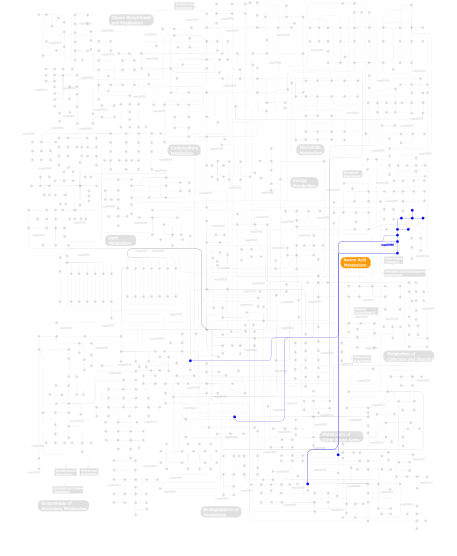
Click the image to view the interactive version of the map in iPath% proteins involved KEGG pathway ID Description 75.69 map04120 Ubiquitin mediated proteolysis 20.41 map05020 Parkinson's disease 3.67 map05040 Huntington's disease 0.23  map00380
Tryptophan metabolism This information is based on mapping of SMART genomic protein database to KEGG orthologous groups. Percentage points are related to the number of proteins with UBCc domain which could be assigned to a KEGG orthologous group, and not all proteins containing UBCc domain. Please note that proteins can be included in multiple pathways, ie. the numbers above will not always add up to 100%.
- Structure (3D structures containing this domain)
3D Structures of UBCc domains in PDB
PDB code Main view Title 1a3s 
HUMAN UBC9 1ayz 
CRYSTAL STRUCTURE OF THE SACCHAROMYCES CEREVISIAE UBIQUITIN-CONJUGATING ENZYME RAD6 (UBC2) AT 2.6A RESOLUTION 1c4z 
STRUCTURE OF E6AP: INSIGHTS INTO UBIQUITINATION PATHWAY 1fbv 
STRUCTURE OF A CBL-UBCH7 COMPLEX: RING DOMAIN FUNCTION IN UBIQUITIN-PROTEIN LIGASES 1fxt 
STRUCTURE OF A CONJUGATING ENZYME-UBIQUITIN THIOLESTER COMPLEX 1fzy 
CRYSTAL STRUCTURE OF SACCHAROMYCES CEREVISIAE UBIQUITIN CONJUGATING ENZYME 1 1i7k 
CRYSTAL STRUCTURE OF HUMAN MITOTIC-SPECIFIC UBIQUITIN-CONJUGATING ENZYME, UBCH10 1j74 
Crystal Structure of Mms2 1j7d 
Crystal Structure of hMms2-hUbc13 1jas 
HsUbc2b 1jat 
Mms2/Ubc13 Ubiquitin Conjugating Enzyme Complex 1jbb 
Ubiquitin Conjugating Enzyme, Ubc13 1kpp 
Structure of the Tsg101 UEV domain 1kpq 
Structure of the Tsg101 UEV domain 1kps 
Structural Basis for E2-mediated SUMO conjugation revealed by a complex between ubiquitin conjugating enzyme Ubc9 and RanGAP1 1m4p 
Structure of the Tsg101 UEV domain in complex with a HIV-1 PTAP ""late domain"" peptide, DYANA Ensemble 1m4q 
STRUCTURE OF THE TSG101 UEV DOMAIN IN COMPLEX WITH A HIV-1 PTAP ""LATE DOMAIN"" PEPTIDE, CNS ENSEMBLE 1pzv 
Crystal structures of two UBC (E2) enzymes of the ubiquitin-conjugating system in Caenorhabditis elegans 1q34 
Crystal structures of two UBC (E2) enzymes of the ubiquitin-conjugating system in Caenorhabditis elegans 1qcq 
UBIQUITIN CONJUGATING ENZYME 1s1q 
TSG101(UEV) domain in complex with Ubiquitin 1tte 
The Structure of a Class II ubiquitin-conjugating enzyme, Ubc1. 1u9a 
HUMAN UBIQUITIN-CONJUGATING ENZYME UBC9 1u9b 
MURINE/HUMAN UBIQUITIN-CONJUGATING ENZYME UBC9 1ur6 
NMR based structural model of the UbcH5B-CNOT4 complex 1uzx 
A complex of the Vps23 UEV with ubiquitin 1w4u 
NMR solution structure of the ubiquitin conjugating enzyme UbcH5B 1wzv 
Crystal Structure of UbcH8 1wzw 
Crystal Structure of UbcH8 1x23 
Crystal structure of ubch5c 1y6l 
Human ubiquitin conjugating enzyme E2E2 1y8x 
Structural basis for recruitment of Ubc12 by an E2-binding domain in NEDD8's E1 1yf9 
Structural analysis of Leishmania major ubiquitin conjugating enzyme E2 1yh2 
Ubiquitin-Conjugating Enzyme HSPC150 1yla 
Ubiquitin-conjugating enzyme E2-25 kDa (Huntington interacting protein 2) 1yrv 
Novel Ubiquitin-Conjugating Enzyme 1z2u 
The 1.1A crystallographic structure of ubiquitin-conjugating enzyme (ubc-2) from Caenorhabditis elegans: functional and evolutionary significance 1z3d 
Protein crystal growth improvement leading to the 2.5A crystallographic structure of ubiquitin-conjugating enzyme (ubc-1) from Caenorhabditis elegans 1z5s 
Crystal structure of a complex between UBC9, SUMO-1, RANGAP1 and NUP358/RANBP2 1zdn 
Ubiquitin-conjugating enzyme E2S 1zgu 
Solution structure of the human Mms2-Ubiquitin complex 1zuo 
Structure of Human Ubiquitin-Conjugating Enzyme (UBCi) Involved in Embryo Attachment and Implantation 2a4d 
Structure of the human ubiquitin-conjugating enzyme E2 variant 1 (UEV-1) 2a7l 
Structure of the human hypothetical ubiquitin-conjugating enzyme, LOC55284 2aak 
UBIQUITIN CONJUGATING ENZYME FROM ARABIDOPSIS THALIANA 2awf 
Structure of human Ubiquitin-conjugating enzyme E2 G1 2ayv 
Crystal structure of a putative ubiquitin-conjugating enzyme E2 from Toxoplasma gondii 2bep 
Crystal structure of ubiquitin conjugating enzyme E2-25K 2bf8 
Crystal structure of SUMO modified ubiquitin conjugating enzyme E2- 25K 2c2v 
Crystal structure of the CHIP-UBC13-UEV1a complex 2c4p 
Crystal structure of human ubiquitin-conjugating enzyme UbcH5A 2clw 
Crystal structure of human ubiquitin-conjugating enzyme UbcH5B 2cyx 
Structure of human ubiquitin-conjugating enzyme E2 G2 (UBE2G2/UBC7) 2e2c 
E2-C, AN UBIQUITIN CONJUGATING ENZYME REQUIRED FOR THE DESTRUCTION OF MITOTIC CYCLINS 2edi 
Solution structure of the UQ_con domain from human NEDD8-conjugating enzyme NCE2 2eke 
Structure of a SUMO-binding-motif mimic bound to Smt3p-Ubc9p: conservation of a noncovalent Ubiquitin-like protein-E2 complex as a platform for selective interactions within a SUMO pathway 2esk 
Human Ubiquitin-Conjugating Enzyme (E2) UbcH5b, wild-type 2eso 
Human Ubiquitin-Conjugating Enzyme (E2) UbcH5b mutant Ile37Ala 2esp 
Human ubiquitin-conjugating enzyme (E2) UbcH5b mutant Ile88Ala 2esq 
Human Ubiquitin-Conjugating Enzyme (E2) UbcH5b mutant Ser94Gly 2f0r 
Crystallographic structure of human Tsg101 UEV domain 2f4w 
Human ubiquitin-conjugating enzyme E2 J2 2f4z 
Toxoplasma gondii ubiquitin conjugating enzyme TgTwinScan_2721- E2 domain 2fo3 
Plasmodium vivax ubiquitin conjugating enzyme E2 2fuh 
Solution Structure of the UbcH5c/Ub Non-covalent Complex 2gjd 
Distinct functional domains of Ubc9 dictate cell survival and resistance to genotoxic stress 2gmi 
Mms2/Ubc13~Ubiquitin 2grn 
Crystal Structure of human RanGAP1-Ubc9 2gro 
Crystal Structure of human RanGAP1-Ubc9-N85Q 2grp 
Crystal Structure of human RanGAP1-Ubc9-Y87A 2grq 
Crystal Structure of human RanGAP1-Ubc9-D127A 2grr 
Crystal Structure of human RanGAP1-Ubc9-D127S 2h2y 
Crystal structure of ubiquitin conjugating enzyme E2 from plasmodium falciparum 2hlw 
Solution Structure of the Human Ubiquitin-conjugating Enzyme Variant Uev1a 2kjh 
NMR based structural model of the UBCH8-UBIQUITIN complex 2kly 
Solution structure of human ubiquitin conjugating enzyme Ube2g2 2lxp 
NMR structure of two domains in ubiquitin ligase gp78, RING and G2BR, bound to its conjugating enzyme Ube2g 2mt6 
2MT6 2nvu 
Structure of APPBP1-UBA3~NEDD8-NEDD8-MgATP-Ubc12(C111A), a trapped ubiquitin-like protein activation complex 2o25 
Ubiquitin-Conjugating Enzyme E2-25 kDa Complexed With SUMO-1-Conjugating Enzyme UBC9 2ob4 
Human Ubiquitin-Conjugating Enzyme CDC34 2onu 
Plasmodium falciparum ubiquitin conjugating enzyme PF10_0330, putative homologue of human UBE2H 2oxq 
Structure of the UbcH5 :CHIP U-box complex 2pe6 
Non-covalent complex between human SUMO-1 and human Ubc9 2pwq 
Crystal structure of a putative ubiquitin conjugating enzyme from Plasmodium yoelii 2px9 
The intrinsic affinity between E2 and the Cys domain of E1 in Ubiquitin-like modifications 2q0v 
Crystal structure of ubiquitin conjugating enzyme E2, putative, from Plasmodium falciparum 2qgx 
Ubiquitin-conjugating enzyme E2Q 2r0j 
Crystal structure of the putative ubiquitin conjugating enzyme, PFE1350c, from Plasmodium falciparum 2ucz 
UBIQUITIN CONJUGATING ENZYME (UBC7) FROM SACCHAROMYCES CEREVISIAE 2uyz 
Non-covalent complex between Ubc9 and SUMO1 2vrr 
Structure of SUMO modified Ubc9 2xwu 
CRYSTAL STRUCTURE OF IMPORTIN 13 - UBC9 COMPLEX 2y4w 
Solution structure of human ubiquitin conjugating enzyme Rad6b 2y9m 
Pex4p-Pex22p structure 2y9p 
Pex4p-Pex22p mutant II structure 2yb6 
Native human Rad6 2ybf 
Complex of Rad18 (Rad6 binding domain) with Rad6b 2yho 
The IDOL-UBE2D complex mediates sterol-dependent degradation of the LDL receptor 2z5d 
Human ubiquitin-conjugating enzyme E2 H 3a33 
UbcH5b~Ubiquitin Conjugate 3a4s 
The crystal structure of the SLD2:Ubc9 complex 3bzh 
Crystal structure of human ubiquitin-conjugating enzyme E2 E1 3ceg 
Crystal structure of the UBC domain of baculoviral IAP repeat-containing protein 6 3e46 
Crystal structure of ubiquitin-conjugating enzyme E2-25kDa (Huntington interacting protein 2) M172A mutant 3e95 
Crystal Structure of the Plasmodium Falciparum ubiquitin conjugating enzyme complex, PfUBC13-PfUev1a 3eb6 
Structure of the cIAP2 RING domain bound to UbcH5b 3f92 
Crystal structure of ubiquitin-conjugating enzyme E2-25kDa (Huntington Interacting Protein 2) M172A mutant crystallized at pH 8.5 3fn1 
E2-RING expansion of the NEDD8 cascade confers specificity to cullin modification. 3fsh 
Crystal structure of the ubiquitin conjugating enzyme Ube2g2 bound to the G2BR domain of ubiquitin ligase gp78 3h8k 
Crystal structure of Ube2g2 complxed with the G2BR domain of gp78 at 1.8-A resolution 3hct 
Crystal structure of TRAF6 in complex with Ubc13 in the P1 space group 3hcu 
Crystal structure of TRAF6 in complex with Ubc13 in the C2 space group 3jvz 
E2~Ubiquitin-HECT 3jw0 
E2~Ubiquitin-HECT 3k9o 
The crystal structure of E2-25K and UBB+1 complex 3k9p 
The crystal structure of E2-25K and ubiquitin complex 3l1y 
Crystal structure of human UBC4 E2 conjugating enzyme 3l1z 
Crystal structure of the U-BOX domain of human E4B ubiquitin ligase in complex with UBCH5C E2 ubiquitin conjugating enzyme 3o2u 
S. cerevisiae Ubc12 3obq 
Crystal Structure of the Tsg101 UEV domain in complex with a human HRS PSAP peptide 3obs 
Crystal structure of Tsg101 UEV domain 3obu 
Crystal structure of the Tsg101 UEV domain in complex with a HIV-1 PTAP peptide 3obx 
Crystal structure of the Tsg101 UEV domain in complex with a HIV-1 Gag P7A mutant peptide 3oj4 
Crystal structure of the A20 ZnF4, ubiquitin and UbcH5A complex 3ong 
Crystal structure of UBA2ufd-Ubc9: insights into E1-E2 interactions in Sumo pathways 3p9g 
Crystal structure of the TSG101 UEV domain in complex with FA459 peptide 3p9h 
Crystal structure of the TSG101 UEV domain in complex with FA258 peptide 3ptf 
X-ray structure of the non-covalent complex between UbcH5A and Ubiquitin 3r3q 
Crystal structure of the yeast Vps23 UEV domain 3r42 
Crystal structure of the yeast vps23 UEV domain in complex with a vps27 PSDP peptide 3rcz 
Rad60 SLD2 Ubc9 Complex 3rpg 
Bmi1/Ring1b-UbcH5c complex structure 3rz3 
Human Cdc34 E2 in complex with CC0651 inhibitor 3sqv 
Crystal Structure of E. coli O157:H7 E3 ubiquitin ligase, NleL, with a human E2, UbcH7 3sy2 
Crystal structure of the Salmonella E3 ubiquitin ligase SopA in complex with the human E2 UbcH7 3tgd 
Crystal structure of the human ubiquitin-conjugating enzyme (E2) UbcH5b 3ugb 
UbcH5c~Ubiquitin Conjugate 3uin 
Complex between human RanGAP1-SUMO2, UBC9 and the IR1 domain from RanBP2 3uio 
Complex between human RanGAP1-SUMO2, UBC9 and the IR1 domain from RanBP2 containing IR2 Motif II 3uip 
Complex between human RanGAP1-SUMO1, UBC9 and the IR1 domain from RanBP2 containing IR2 Motif II 3von 
Crystalstructure of the ubiquitin protease 3w31 
Structual basis for the recognition of Ubc13 by the Shigella flexneri effector OspI 3we5 
3WE5 3zni 
Structure of phosphoTyr363-Cbl-b - UbcH5B-Ub - ZAP-70 peptide complex 4a49 
Structure of phosphoTyr371-c-Cbl-UbcH5B complex 4a4b 
Structure of modified phosphoTyr371-c-Cbl-UbcH5B-ZAP-70 complex 4a4c 
Structure of phosphoTyr371-c-Cbl-UbcH5B-ZAP-70 complex 4ap4 
Rnf4 - ubch5a - ubiquitin heterotrimeric complex 4auq 
Structure of BIRC7-UbcH5b-Ub complex. 4bvu 
Structure of Shigella effector OspG in complex with host UbcH5c- Ubiquitin conjugate 4bwf 
Pex4p-Pex22p disulphide bond mutant 4ccg 
Structure of an E2-E3 complex 4ddg 
Crystal structure of human OTUB1/UbcH5b~Ub/Ub 4ddi 
Crystal structure of human OTUB1/UbcH5b~Ub/Ub 4dhi 
Structure of C. elegans OTUB1 bound to human UBC13 4dhj 
The structure of a ceOTUB1 ubiquitin aldehyde UBC13~Ub complex 4dhz 
The structure of h/ceOTUB1-ubiquitin aldehyde-UBC13~Ub 4ds2 
Ubiquitin conjugating enzyme (putative) from Trypanosoma cruzi 4eje 
Structure Of The Tsg101 UEV Domain In Complex With an Ebola PTAP late Domain Peptide 4fh1 
S. cerevisiae Ubc13-N79A 4gpr 
Crystal structure of EhUbc5, a ubiquitin conjugating enzyme from Entamoeba histolytica 4ii2 
Crystal structure of Ubiquitin activating enzyme 1 (Uba1) in complex with the Ub E2 Ubc4, ubiquitin, and ATP/Mg 4ip3 
Complex structure of OspI and Ubc13 4jqu 
Crystal structure of Ubc7p in complex with the U7BR of Cue1p 4jue 
Crystal structure of Plasmodium falciparum ubiquitin conjugating enzyme UBC9 4l83 
Structure of a putative Ubiquitin-conjugating enzyme E2 from Brugia malayi 4lad 
Crystal Structure of the Ube2g2:RING-G2BR complex 4ldt 
The structure of h/ceOTUB1-ubiquitin aldehyde-UBCH5B~Ub 4m1n 
Crystal structure of Plasmodium falciparum ubiquitin conjugating enzyme UBC9 4mdk 
Cdc34-ubiquitin-CC0651 complex 4nr3 
4NR3 4nrg 
4NRG 4nri 
4NRI 4onl 
4ONL 4onm 
4ONM 4onn 
4ONN 4orh 
Crystal structure of RNF8 bound to the UBC13/MMS2 heterodimer 4p5o 
4P5O 4q5e 
4Q5E 4q5h 
4Q5H 4qpl 
4QPL 4r62 
4R62 4r8p 
4R8P 4s3o 
4S3O 4tkp 
4TKP 4v3k 
4V3K 4v3l 
4V3L 4w5v 
4W5V 4whv 
4WHV 4wz3 
4WZ3 4x57 
4X57 4y1l 
4Y1L 4yc1 
4YC1 4yii 
4YII 4zny 
4ZNY 5a31 
5A31 5a4p 
5A4P 5aie 
5AIE 5ait 
5AIT 5aiu 
5AIU 5bnb 
5BNB 5d0k 
5D0K 5d0m 
5D0M 5d1k 
5D1K 5d1l 
5D1L 5d1m 
5D1M 5d2m 
5D2M 5dfl 
5DFL 5edv 
5EDV 5egg 
5EGG 5eya 
5EYA 5f6d 
5F6D 5f6e 
5F6E 5f6u 
5F6U 5f6v 
5F6V 5f6w 
5F6W 5f6x 
5F6X 5f6y 
5F6Y 5fer 
5FER 5fq2 
5FQ2 5hpt 
5HPT 5ifr 
5IFR 5jne 
5JNE 5khr 
5KHR 5l9t 
5L9T 5l9u 
5L9U - Links (links to other resources describing this domain)
-
PFAM UQ_con