The BAH (bromo-adjacent homology) is commonly found in chromatin-associated proteins [ (PUBMED:23907388) ]. It is found in proteins such as eukaryotic DNA (cytosine-5) methyltransferases IPR001525 the origin recognition complex 1 (Orc1) proteins, as well as several proteins involved in transcriptional regulation. The BAH domain appears to act as a protein-protein interaction module specialised in gene silencing, as suggested for example by its interaction within yeast Orc1p with the silent information regulator Sir1p. The BAH module might therefore play an important role by linking DNA methylation, replication and transcriptional regulation [ (PUBMED:10100640) ].
The BAH (bromo-adjacent homology) domain: a link between DNA methylation, replication and transcriptional regulation.
FEBS Lett. 1999; 446: 189-93
Display abstract
Using sensitive methods of sequence analysis including hydrophobic cluster analysis, we report here a hitherto undescribed family of modules, the BAH (bromo-adjacent homology) family, which includes proteins such as eukaryotic DNA (cytosine-5) methyltransferases, the origin recognition complex 1 (Orc1) proteins, as well as several proteins involved in transcriptional regulation. The BAH domain appears to act as a protein-protein interaction module specialized in gene silencing, as suggested for example by its interaction within yeast Orc1p with the silent information regulator Sir1p. The BAH module might therefore play an important role by linking DNA methylation, replication and transcriptional regulation.
Molecular cloning of polybromo, a nuclear protein containing multiple domains including five bromodomains, a truncated HMG-box, and two repeats of a novel domain.
Gene. 1996; 175: 233-40
Display abstract
A number of transcription factors that act as adaptor proteins have been found to contain an 87 amino acid domain called the bromodomain. In a study to identify and characterise bromodomain proteins expressed in chicken cells, a novel gene has been isolated which encodes five repeats of the bromodomain. In addition, the encoded protein, termed polybromo, contains four other domains: an unusual truncated HMG box, two repeats of a novel domain which we term the BAH domain and a sequence related to a region within the regulatory domain of the DNA cytosine-5 methyltransferase enzyme. Polybromo was found to be related to a yeast protein U19102 which has two bromo domains, a BAH domain and the DNA methyltransferase-related sequence. Antibodies that were raised against polybromo were used in confocal microscopy analysis to show that the 180-kDa polybromo protein is located within the nucleus but excluded from the nucleolus. Gel filtration analysis of nuclear extracts demonstrate that polybromo is part of a large complex with a mass of approximately 2 million dalton.
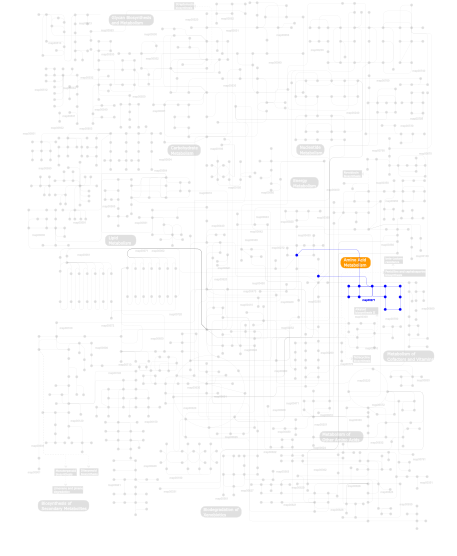
Metabolism (metabolic pathways involving proteins which contain this domain)
Click the image to view the interactive version of the map in iPath
This information is based on mapping of SMART genomic protein database to KEGG orthologous groups. Percentage points are related to the number of proteins with BAH domain which could be assigned to a KEGG orthologous group, and not all proteins containing BAH domain. Please note that proteins can be included in multiple pathways, ie. the numbers above will not always add up to 100%.