This entry represents a conserved region from the common kinase core found in the type I phosphatidylinositol-4-phosphate 5-kinase (PIP5K) family as described in [ (PUBMED:9535851) ]. This region is found in I, II and III phosphatidylinositol-4-phosphate 5-kinases (PIP5K enzymes). PIP5K catalyses the formation of phosphoinositol-4,5-bisphosphate via the phosphorylation of phosphatidylinositol-4-phosphate a precursor in the phosphinositide signalling pathway.
GO process:
phosphatidylinositol metabolic process (GO:0046488)
Structure of type IIbeta phosphatidylinositol phosphate kinase: a protein kinase fold flattened for interfacial phosphorylation.
Cell. 1998; 94: 829-39
Display abstract
Phosphoinositide kinases play central roles in signal transduction by phosphorylating the inositol ring at specific positions. The structure of one such enzyme, type IIbeta phosphatidylinositol phosphate kinase, reveals a protein kinase ATP-binding core and demonstrates that all phosphoinositide kinases belong to one superfamily. The enzyme is a disc-shaped homodimer with a 33 x 48 A basic flat face that suggests an electrostatic mechanism for plasma membrane targeting. Conserved basic residues form a putative phosphatidylinositol phosphate specificity site. The substrate-binding site is open on one side, consistent with dual specificity for phosphatidylinositol 3- and 5-phosphates. A modeled complex with membrane-bound substrate and ATP shows how a phosphoinositide kinase can phosphorylate its substrate in situ at the membrane interface.
The sequence of phosphatidylinositol-4-phosphate 5-kinase defines a novel family of lipid kinases.
J Biol Chem. 1995; 270: 2881-4
Display abstract
Phosphatidylinositol 4,5-bisphosphate (PtdIns(4,5)P2) occupies an essential position in the phosphoinositide signal transduction cascades as the precursor to second messengers and is thought to regulate many cellular proteins directly. The final step in the synthesis of PtdIns(4,5)P2 is the phosphorylation of PtdIns(4)P- by PtdIns(4)P 5-kinase (PIP5K). Using peptide sequences from a purified PIP5K, a cDNA for a human placental PIP5K was isolated and sequenced. Expression of this cDNA in Escherichia coli produced an active PIP5K. Surprisingly, the sequence of this PIP5K has no homology to known PtdIns kinases or protein kinases. However, the PIP5K is homologous to the Saccharomyces cerevisiae proteins Fab1p and Mss4p.
Phosphatidylinositol 4-kinase: gene structure and requirement for yeast cell viability.
Science. 1993; 262: 1444-8
Display abstract
Phosphatidylinositol (PtdIns) 4-kinase catalyzes the first step in the biosynthesis of PtdIns-4,5-bisphosphate (PtdIns[4,5]P2). Hydrolysis of PtdIns[4,5]P2 in response to extracellular stimuli is thought to initiate intracellular signaling cascades that modulate cell proliferation and differentiation. The PIK1 gene encoding a PtdIns 4-kinase from the yeast Saccharomyces cerevisiae was isolated by polymerase chain reaction (PCR) with oligonucleotides based on the sequence of peptides derived from the purified enzyme. The sequence of the PIK1 gene product bears similarities to that of PtdIns 3-kinases from mammals (p110) and yeast (Vps34p). Expression of PIK1 from a multicopy plasmid elevated PtdIns 4-kinase activity and enhanced the response to mating pheromone. A pik1 null mutant was inviable, indicating that PtdIns4P and presumably PtdIns[4,5]P2 are indispensable phospholipids.
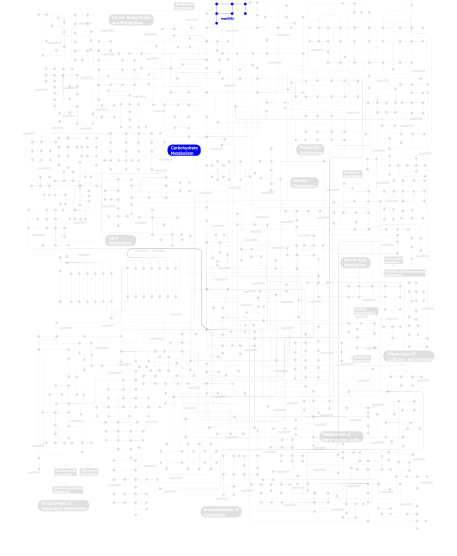
Metabolism (metabolic pathways involving proteins which contain this domain)
Click the image to view the interactive version of the map in iPath
This information is based on mapping of SMART genomic protein database to KEGG orthologous groups. Percentage points are related to the number of proteins with PIPKc domain which could be assigned to a KEGG orthologous group, and not all proteins containing PIPKc domain. Please note that proteins can be included in multiple pathways, ie. the numbers above will not always add up to 100%.