

PI3KaPhosphoinositide 3-kinase family, accessory domain (PIK domain) |
|---|
| SMART accession number: | SM00145 |
|---|---|
| Description: | PIK domain is conserved in all PI3 and PI4-kinases. Its role is unclear but it has been suggested to be involved in substrate presentation. |
| Interpro abstract (IPR001263): | Phosphatidylinositol 3-kinase (PI3K) ( EC 2.7.1.137 ) is an enzyme that phosphorylates phosphoinositides on the 3-hydroxyl group of the inositol ring. The role of the accessory domain of phosphoinositide 3-kinase (PI3-kinase) is unclear. It may be involved in substrate presentation [ (PUBMED:8248783) ]. |
| Family alignment: |
There are 6540 PI3Ka domains in 6534 proteins in SMART's nrdb database.
Click on the following links for more information.
- Evolution (species in which this domain is found)
-
Taxonomic distribution of proteins containing PI3Ka domain.
This tree includes only several representative species. The complete taxonomic breakdown of all proteins with PI3Ka domain is also avaliable.
Click on the protein counts, or double click on taxonomic names to display all proteins containing PI3Ka domain in the selected taxonomic class.
- Cellular role (predicted cellular role)
-
Binding / catalysis: unknown
- Literature (relevant references for this domain)
-
Primary literature is listed below; Automatically-derived, secondary literature is also avaliable.
- Walker EH, Perisic O, Ried C, Stephens L, Williams RL
- Structural insights into phosphoinositide 3-kinase catalysis and signalling.
- Nature. 1999; 402: 313-20
- Display abstract
Phosphoinositide 3-kinases (PI3Ks) are ubiquitous lipid kinases that function both as signal transducers downstream of cell-surface receptors and in constitutive intracellular membrane and protein trafficking pathways. All PI3Ks are dual-specificity enzymes with a lipid kinase activity which phosphorylates phosphoinositides at the 3-hydroxyl, and a protein kinase activity. The products of PI3K-catalysed reactions, phosphatidylinositol 3,4,5-trisphosphate (PtdIns(3,4,5)P3), PtdIns(3,4)P2 and PtdIns(3)P, are second messengers in a variety of signal transduction pathways, including those essential to cell proliferation, adhesion, survival, cytoskeletal rearrangement and vesicle trafficking. Here we report the 2.2 A X-ray crystallographic structure of the catalytic subunit of PI3Kgamma, the class I enzyme that is activated by heterotrimeric G-protein betagamma subunits and Ras. PI3Kgamma has a modular organization centred around a helical-domain spine, with C2 and catalytic domains positioned to interact with phospholipid membranes, and a Ras-binding domain placed against the catalytic domain where it could drive allosteric activation of the enzyme.
- Domin J, Waterfield MD
- Using structure to define the function of phosphoinositide 3-kinase family members.
- FEBS Lett. 1997; 410: 91-5
- Toker A, Cantley LC
- Signalling through the lipid products of phosphoinositide-3-OH kinase.
- Nature. 1997; 387: 673-6
- Display abstract
When a stimulatory agonist molecule binds at the exterior of the cell membrane, a second messenger transduces the signal to the interior of the cell. Second messengers can be derived from phospholipids in the membrane by the action of the enzymes phospholipase C or phosphoinositide-3-OH kinase (PI(3)K). PI(3)K is a key player in many cellular responses, including the movement of organelle membranes, shape alteration through rearrangement of cytoskeletal actin, transformation and chemotaxis. But how PI(3)K mediates these responses is only now becoming clear.
- Vanhaesebroeck B, Leevers SJ, Panayotou G, Waterfield MD
- Phosphoinositide 3-kinases: a conserved family of signal transducers.
- Trends Biochem Sci. 1997; 22: 267-72
- Display abstract
Phosphoinositide 3-kinases (PI3Ks) generate lipids that are implicated in receptor-stimulated signalling and in the regulation of membrane traffic. Several distinct classes of PI3Ks have now been identified that have been conserved throughout eukaryotic evolution. Potential signalling pathways downstream of PI3Ks have been elucidated and PI3K function is now being characterised in several model organisms.
- Kapeller R, Cantley LC
- Phosphatidylinositol 3-kinase.
- Bioessays. 1994; 16: 565-76
- Display abstract
Currently, a central question in biology is how signals from the cell surface modulate intracellular processes. In recent years phosphoinositides have been shown to play a key role in signal transduction. Two phosphoinositide pathways have been characterized, to date. In the canonical phosphoinositide turnover pathway, activation of phosphatidylinositol-specific phospholipase C results in the hydrolysis of phosphatidylinositol 4,5-bisphosphate and the generation of two second messengers, inositol 1,4,5-trisphosphate and diacylglycerol. The 3-phosphoinositide pathway involves protein-tyrosine kinase-mediated recruitment and activation of phosphatidylinositol 3-kinase, resulting in the production of phosphatidylinositol 3,4-bisphosphate and phosphatidylinositol 3,4,5-trisphosphate. The 3-phosphoinositides are not substrates of any known phospholipase C, are not components of the canonical phosphoinositide turnover pathway, and may themselves act as intracellular mediators. The 3-phosphoinositide pathway has been implicated in growth factor-dependent mitogenesis, membrane ruffling and glucose uptake. Furthermore the homology of the yeast vps34 with the mammalian phosphatidylinositol 3-kinase has suggested a role for this pathway in vesicular trafficking. In this review the different mechanisms employed by protein-tyrosine kinases to activate phosphatidylinositol 3-kinase, and its involvement in the signaling cascade initiated by tyrosine phosphorylation, are examined.
- Flanagan CA, Schnieders EA, Emerick AW, Kunisawa R, Admon A, Thorner J
- Phosphatidylinositol 4-kinase: gene structure and requirement for yeast cell viability.
- Science. 1993; 262: 1444-8
- Display abstract
Phosphatidylinositol (PtdIns) 4-kinase catalyzes the first step in the biosynthesis of PtdIns-4,5-bisphosphate (PtdIns[4,5]P2). Hydrolysis of PtdIns[4,5]P2 in response to extracellular stimuli is thought to initiate intracellular signaling cascades that modulate cell proliferation and differentiation. The PIK1 gene encoding a PtdIns 4-kinase from the yeast Saccharomyces cerevisiae was isolated by polymerase chain reaction (PCR) with oligonucleotides based on the sequence of peptides derived from the purified enzyme. The sequence of the PIK1 gene product bears similarities to that of PtdIns 3-kinases from mammals (p110) and yeast (Vps34p). Expression of PIK1 from a multicopy plasmid elevated PtdIns 4-kinase activity and enhanced the response to mating pheromone. A pik1 null mutant was inviable, indicating that PtdIns4P and presumably PtdIns[4,5]P2 are indispensable phospholipids.
- Metabolism (metabolic pathways involving proteins which contain this domain)
-
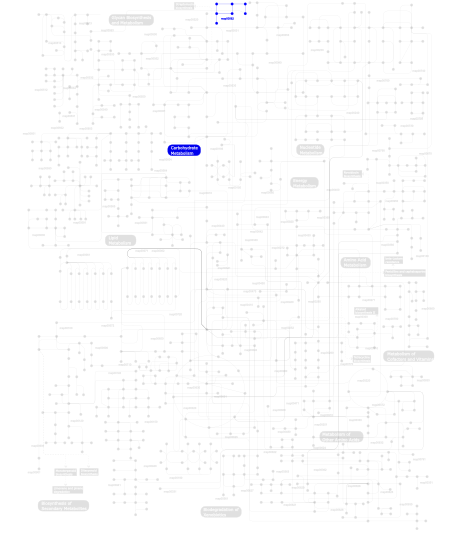
Click the image to view the interactive version of the map in iPath% proteins involved KEGG pathway ID Description 8.46 map04070 Phosphatidylinositol signaling system 6.98  map00562
Inositol phosphate metabolism 3.05 map05222 Small cell lung cancer 3.05 map04664 Fc epsilon RI signaling pathway 3.05 map05210 Colorectal cancer 3.05 map05213 Endometrial cancer 3.05 map04370 VEGF signaling pathway 3.05 map04620 Toll-like receptor signaling pathway 3.05 map04662 B cell receptor signaling pathway 3.05 map05212 Pancreatic cancer 3.05 map04630 Jak-STAT signaling pathway 3.05 map05220 Chronic myeloid leukemia 3.05 map04210 Apoptosis 3.05 map04510 Focal adhesion 3.05 map04670 Leukocyte transendothelial migration 3.05 map04910 Insulin signaling pathway 3.05 map05215 Prostate cancer 3.05 map05214 Glioma 3.05 map04012 ErbB signaling pathway 3.05 map04810 Regulation of actin cytoskeleton 3.05 map04150 mTOR signaling pathway 3.05 map04660 T cell receptor signaling pathway 3.05 map05211 Renal cell carcinoma 3.05 map05221 Acute myeloid leukemia 3.05 map04930 Type II diabetes mellitus 3.05 map05223 Non-small cell lung cancer 3.05 map05218 Melanoma 3.05 map04650 Natural killer cell mediated cytotoxicity 3.05 map04914 Progesterone-mediated oocyte maturation 2.26 map04140 Regulation of autophagy This information is based on mapping of SMART genomic protein database to KEGG orthologous groups. Percentage points are related to the number of proteins with PI3Ka domain which could be assigned to a KEGG orthologous group, and not all proteins containing PI3Ka domain. Please note that proteins can be included in multiple pathways, ie. the numbers above will not always add up to 100%.
- Structure (3D structures containing this domain)
3D Structures of PI3Ka domains in PDB
PDB code Main view Title 1e7u 
Structure determinants of phosphoinositide 3-kinase inhibition by wortmannin, LY294002, quercetin, myricetin and staurosporine 1e7v 
Structure determinants of phosphoinositide 3-kinase inhibition by wortmannin, LY294002, quercetin, myricetin and staurosporine 1e8w 
Structure determinants of phosphoinositide 3-kinase inhibition by wortmannin, LY294002, quercetin, myricetin and staurosporine 1e8x 
STRUCTURAL INSIGHTS INTO PHOSHOINOSITIDE 3-KINASE ENZYMATIC MECHANISM AND SIGNALLING 1e8y 
Structure determinants of phosphoinositide 3-kinase inhibition by wortmannin, LY294002, quercetin, myricetin and staurosporine 1e8z 
Structure determinants of phosphoinositide 3-kinase inhibition by wortmannin, LY294002, quercetin, myricetin and staurosporine 1e90 
Structure determinants of phosphoinositide 3-kinase inhibition by wortmannin, LY294002, quercetin, myricetin and staurosporine 1he8 
Ras G12V - PI 3-kinase gamma complex 2a4z 
Crystal Structure of human PI3Kgamma complexed with AS604850 2a5u 
Crystal Structure of human PI3Kgamma complexed with AS605240 2chw 
A pharmacological map of the PI3-K family defines a role for p110 alpha in signaling: The structure of complex of phosphoinositide 3- kinase gamma with inhibitor PIK-39 2chx 
A pharmacological map of the PI3-K family defines a role for p110alpha in signaling: The structure of complex of phosphoinositide 3-kinase gamma with inhibitor PIK-90 2chz 
A pharmacological map of the PI3-K family defines a role for p110alpha in signaling: The structure of complex of phosphoinositide 3-kinase gamma with inhibitor PIK-93. 2rd0 
Structure of a human p110alpha/p85alpha complex 2v4l 
complex of human phosphoinositide 3-kinase catalytic subunit gamma ( p110 gamma) with PIK-284 2wxf 
The crystal structure of the murine class IA PI 3-kinase p110delta in complex with PIK-39. 2wxg 
The crystal structure of the murine class IA PI 3-kinase p110delta in complex with SW13. 2wxh 
The crystal structure of the murine class IA PI 3-kinase p110delta in complex with SW14. 2wxi 
The crystal structure of the murine class IA PI 3-kinase p110delta in complex with SW30. 2wxj 
The crystal structure of the murine class IA PI 3-kinase p110delta in complex with INK654. 2wxk 
The crystal structure of the murine class IA PI 3-kinase p110delta in complex with INK666. 2wxl 
The crystal structure of the murine class IA PI 3-kinase p110delta in complex with ZSTK474. 2wxm 
The crystal structure of the murine class IA PI 3-kinase p110delta in complex with DL06. 2wxn 
The crystal structure of the murine class IA PI 3-kinase p110delta in complex with DL07. 2wxo 
The crystal structure of the murine class IA PI 3-kinase p110delta in complex with AS5. 2wxp 
The crystal structure of the murine class IA PI 3-kinase p110delta in complex with GDC-0941. 2wxq 
The crystal structure of the murine class IA PI 3-kinase p110delta in complex with AS15. 2wxr 
The crystal structure of the murine class IA PI 3-kinase p110delta. 2x38 
The crystal structure of the murine class IA PI 3-kinase p110delta in complex with IC87114. 2x6f 
THE CRYSTAL STRUCTURE OF THE DROSOPHILA CLASS III PI3-KINASE VPS34 IN COMPLEX WITH 3-METHYLADENINE 2x6h 
THE CRYSTAL STRUCTURE OF THE DROSOPHILA CLASS III PI3-KINASE VPS34 2x6i 
THE CRYSTAL STRUCTURE OF THE DROSOPHILA CLASS III PI3-KINASE VPS34 IN COMPLEX WITH PIK-90 2x6j 
THE CRYSTAL STRUCTURE OF THE DROSOPHILA CLASS III PI3-KINASE VPS34 IN COMPLEX WITH PIK-93 2x6k 
THE CRYSTAL STRUCTURE OF THE DROSOPHILA CLASS III PI3-KINASE VPS34 IN COMPLEX WITH PI-103 2y3a 
Crystal structure of p110beta in complex with icSH2 of p85beta and the drug GDC-0941 3apc 
Crystal structure of human PI3K-gamma in complex with CH5132799 3apd 
Crystal structure of human PI3K-gamma in complex with CH5108134 3apf 
Crystal structure of human PI3K-gamma in complex with CH5039699 3csf 
Crystal structure of PI3K p110gamma catalytical domain in complex with organoruthenium inhibitor DW2 3cst 
Crystal structure of PI3K p110gamma catalytical domain in complex with organoruthenium inhibitor E5E2 3dbs 
Structure of PI3K gamma in complex with GDC0941 3dpd 
Achieving multi-isoform PI3K inhibition in a series of substituted 3,4-Dihydro-2H-benzo[1,4]oxazines 3ene 
Complex of PI3K gamma with an inhibitor 3hhm 
Crystal structure of p110alpha H1047R mutant in complex with niSH2 of p85alpha and the drug wortmannin 3hiz 
Crystal structure of p110alpha H1047R mutant in complex with niSH2 of p85alpha 3ibe 
Crystal Structure of a Pyrazolopyrimidine Inhibitor Bound to PI3 Kinase Gamma 3ihy 
Human PIK3C3 crystal structure 3l08 
Structure of Pi3K gamma with a potent inhibitor: GSK2126458 3l13 
Crystal Structures of Pan-PI3-Kinase and Dual Pan-PI3-Kinase/mTOR Inhibitors 3l16 
Discovery of (thienopyrimidin-2-yl)aminopyrimidines as Potent, Selective, and Orally Available Pan-PI3-Kinase and Dual Pan-PI3-Kinase/mTOR Inhibitors for the Treatment of Cancer 3l17 
Discovery of (thienopyrimidin-2-yl)aminopyrimidines as Potent, Selective, and Orally Available Pan-PI3-Kinase and Dual Pan-PI3-Kinase/mTOR Inhibitors for the Treatment of Cancer 3l54 
Structure of Pi3K gamma with inhibitor 3lj3 
PI3-kinase-gamma with a pyrrolopyridine-benzofuran inhibitor 3ls8 
Crystal structure of human PIK3C3 in complex with 3-[4-(4-Morpholinyl)thieno[3,2-d]pyrimidin-2-yl]-phenol 3mjw 
PI3 Kinase gamma with a benzofuranone inhibitor 3ml8 
Discovery of the Highly Potent PI3K/mTOR Dual Inhibitor PF-04691502 through Structure Based Drug Design 3ml9 
Discovery of the Highly Potent PI3K/mTOR Dual Inhibitor PF-04691502 through Structure Based Drug Design 3nzs 
Structure-based Optimization of Pyrazolo -Pyrimidine and -Pyridine Inhibitors of PI3-Kinase 3nzu 
Structure-based Optimization of Pyrazolo -Pyrimidine and -Pyridine Inhibitors of PI3-Kinase 3oaw 
4-Methylpteridineones as Orally Active and Selective PI3K/mTOR Dual Inhibitors 3p2b 
Crystal Structure of PI3K gamma with 3-(2-morpholino-6-(pyridin-3-ylamino)pyrimidin-4-yl)phenol 3pre 
Quinazolines with intra-molecular hydrogen bonding scaffold (iMHBS) as PI3K/mTOR dual inhibitors. 3prz 
Quinazolines with intra-molecular hydrogen bonding scaffold (iMHBS) as PI3K/mTOR dual inhibitors. 3ps6 
Quinazolines with intra-molecular hydrogen bonding scaffold (iMHBS) as PI3K/mTOR dual inhibitors. 3qaq 
Crystal structure of PI3K-gamma in complex with triazine-benzimidazole 1 3qar 
Crystal structure of PI3K-gamma in complex with triazine-benzimidazole 32 3qjz 
Crystal structure of PI3K-gamma in complex with benzothiazole 1 3qk0 
Crystal structure of PI3K-gamma in complex with benzothiazole 82 3r7q 
Structure-based design of thienobenzoxepin inhibitors of PI3- kinase 3r7r 
Structure-based design of thienobenzoxepin inhibitors of PI3-Kinase 3s2a 
Crystal structure of PI3K-gamma in complex with a quinoline inhibitor 3sd5 
Crystal Structure of PI3K gamma with 5-(2,4-dimorpholinopyrimidin-6-yl)-4-(trifluoromethyl)pyridin-2-amine 3t8m 
Rational Design of PI3K-alpha Inhibitors that Exhibit Selectivity Over the PI3K-beta Isoform 3tjp 
Crystal Structure of PI3K gamma with N6-(3,4-dimethoxyphenyl)-2-morpholino-[4,5'-bipyrimidine]-2',6-diamine 3tl5 
Discovery of GDC-0980: a Potent, Selective, and Orally Available Class I Phosphatidylinositol 3-Kinase (PI3K)/Mammalian Target of Rapamycin (mTOR) Kinase Inhibitor for the Treatment of Cancer 3zim 
Discovery of a potent and isoform-selective targeted covalent inhibitor of the lipid kinase PI3Kalpha 3zvv 
Fragment Bound to PI3KInase gamma 3zw3 
Fragment based discovery of a novel and selective PI3 Kinase inhibitor 4a55 
Crystal structure of p110alpha in complex with iSH2 of p85alpha and the inhibitor PIK-108 4ajw 
Discovery and Optimization of New Benzimidazole- and Benzoxazole-Pyrimidone Selective PI3KBeta Inhibitors for the Treatment of Phosphatase and TENsin homologue (PTEN)-Deficient Cancers"" 4anu 
Complexes of PI3Kgamma with isoform selective inhibitors. 4anv 
Complexes of PI3Kgamma with isoform selective inhibitors. 4anw 
Complexes of PI3Kgamma with isoform selective inhibitors. 4anx 
Complexes of PI3Kgamma with isoform selective inhibitors. 4aof 
Selective small molecule inhibitor discovered by chemoproteomic assay platform reveals regulation of Th17 cell differentiation by PI3Kgamma 4bfr 
Discovery and Optimization of Pyrimidone Indoline Amide PI3Kbeta Inhibitors for the Treatment of Phosphatase and TENsin homologue ( PTEN)-Deficient Cancers 4dk5 
Crystal structure of human PI3K-gamma in complex with a pyridyl-triazine inhibitor 4ezj 
Potent and Selective Inhibitors of PI3K-delta: Obtaining Isoform Selectivity from the Affinity Pocket and Tryptophan Shelf 4ezk 
Potent and Selective Inhibitors of PI3K-delta: Obtaining Isoform Selectivity from the Affinity Pocket and Tryptophan Shelf 4ezl 
Potent and Selective Inhibitors of PI3K-delta: Obtaining Isoform Selectivity from the Affinity Pocket and Tryptophan Shelf 4f1s 
Crystal structure of human PI3K-gamma in complex with a pyridyl-triazine-sulfonamide inhibitor 4fa6 
Design and Synthesis of a Novel Pyrrolidinyl Pyrido Pyrimidinone Derivative as a Potent Inhibitor of PI3Ka and mTOR 4fad 
Design and Synthesis of a Novel Pyrrolidinyl Pyrido Pyrimidinone Derivative as a Potent Inhibitor of PI3Ka and mTOR 4fhj 
Crystal Structure of PI3K-gamma in Complex with Imidazopyridine 2 4fhk 
Crystal Structure of PI3K-gamma in Complex with Imidazopyridazine 19e 4fjy 
Crystal structure of PI3K-gamma in complex with quinoline-indoline inhibitor 24f 4fjz 
Crystal structure of PI3K-gamma in complex with pyrrolo-pyridine inhibitor 63 4flh 
Crystal structure of human PI3K-gamma in complex with AMG511 4ful 
PI3 Kinase Gamma bound to a pyrmidine inhibitor 4g11 
X-ray structure of PI3K-gamma bound to a 4-(morpholin-4-yl)- (6-oxo-1,6-dihydropyrimidin-2-yl)amide inhibitor 4gb9 
Potent and Highly Selective Benzimidazole Inhibitors of PI3K-delta 4hle 
Compound 21 (1-alkyl-substituted 1,2,4-triazoles) 4hvb 
Catalytic unit of PI3Kg in complex with PI3K/mTOR dual inhibitor PF-04979064 4j6i 
Discovery of thiazolobenzoxepin PI3-kinase inhibitors that spare the PI3-kinase beta isoform 4jps 
Co-crystal Structures of the Lipid Kinase PI3K alpha with Pan and Isoform Selective Inhibitors 4kz0 
Structure of PI3K gamma with Imidazopyridine inhibitors 4kzc 
Structure of PI3K gamma with Imidazopyridine inhibitors 4l1b 
Crystal Structure of p110alpha complexed with niSH2 of p85alpha 4l23 
Crystal Structure of p110alpha complexed with niSH2 of p85alpha and PI-103 4l2y 
Crystal Structure of p110alpha complexed with niSH2 of p85alpha and compound 9d 4ovu 
4OVU 4ovv 
4OVV 4oys 
4OYS 4ph4 
4PH4 4ps3 
Structure of PI3K gamma in complex with 1-[6-(5-methoxypyridin-3-yl)-1,3-benzothiazol-2-yl]-3-[2-(1-propyl-1H-imidazol-4-yl)ethyl]urea 4ps7 
Structure of PI3K gamma in complex with N-[6-(pyridin-3-yl)-1,3-benzothiazol-2-yl]acetamide 4ps8 
Structure of PI3K gamma in complex with N-[6-(5,6-dimethoxypyridin-3-yl)-1,3-benzothiazol-2-yl]acetamide 4tuu 
4TUU 4tv3 
4TV3 4urk 
4URK 4uwf 
4UWF 4uwg 
4UWG 4uwh 
4UWH 4uwk 
4UWK 4uwl 
4UWL 4v0i 
4V0I 4waf 
4WAF 4wwn 
4WWN 4wwo 
4WWO 4wwp 
4WWP 4xe0 
4XE0 4xx5 
4XX5 4xz4 
4XZ4 4ykn 
4YKN 4zop 
4ZOP 5ae8 
5AE8 5ae9 
5AE9 5anl 
5ANL 5dfz 
5DFZ 5dxh 
5DXH 5dxt 
5DXT 5dxu 
5DXU 5eds 
5EDS 5enn 
5ENN 5fi4 
5FI4 5g2n 
5G2N 5g55 
5G55 5is5 
5IS5 5itd 
5ITD 5kc2 
5KC2 5l72 
5L72 - Links (links to other resources describing this domain)
-
INTERPRO IPR001263