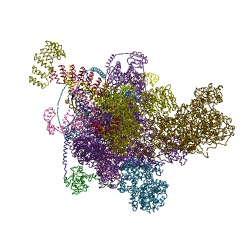
| SMART accession number: | SM00651
|
|---|
| Description: |
small nuclear ribonucleoprotein particles (snRNPs) involved in pre-mRNA splicing |
| Interpro abstract (IPR006649): |
This family is found in Lsm (like-Sm) proteins, which have a core structure consisting of an open beta-barrel with an SH3-like topology. Lsm (like-Sm) proteins have diverse functions, and are thought to be important modulators of RNA biogenesis and function [(PUBMED:10801455), (PUBMED:12438310)]. The Sm proteins form part of specific small nuclear ribonucleoproteins (snRNPs) that are involved in the processing of pre-mRNAs to mature mRNAs, and are a major component of the eukaryotic spliceosome. Most snRNPs consist of seven Sm proteins (B/B', D1, D2, D3, E, F and G) arranged in a ring on a uridine-rich sequence (Sm site), plus a small nuclear RNA (snRNA) (either U1, U2, U5 or U4/6) [(PUBMED:15130578)]. All Sm proteins contain a common sequence motif in two segments, Sm1 and Sm2, separated by a short variable linker [(PUBMED:7744013)]. Other snRNPs, such as U7 snRNP, can contain different Lsm proteins. Lsm proteins are also found in archaebacteria, which do not have any splicing apparatus, suggesting a more general role for Lsm proteins. Archaeal Lsm proteins have been shown to bind to small RNAs and are probably involved in many cellular processes [(PUBMED:20826804)]. Archaeal Lsm proteins are likely to represent the ancestral Lsm domain [(PUBMED:11399068)].
|
| Family alignment: |
|
|---|
Click on the following links for more information.
- Evolution (species in which this domain is found)
-
- Cellular role (predicted cellular role)
-
Binding / catalysis: protein binding
- Literature (relevant references for this domain)
-
Primary literature is listed below; Automatically-derived, secondary literature is also avaliable.
- Kambach C et al.
- Crystal structures of two Sm protein complexes and their implications for the assembly of the spliceosomal snRNPs.
- Cell. 1999; 96: 375-87
- Display abstract
The U1, U2, U4/U6, and U5 small nuclear ribonucleoprotein particles (snRNPs) involved in pre-mRNA splicing contain seven Sm proteins (B/B', D1, D2, D3, E, F, and G) in common, which assemble around the Sm site present in four of the major spliceosomal small nuclear RNAs (snRNAs). These proteins share a common sequence motif in two segments, Sm1 and Sm2, separated by a short variable linker. Crystal structures of two Sm protein complexes, D3B and D1D2, show that these proteins have a common fold containing an N-terminal helix followed by a strongly bent five-stranded antiparallel beta sheet, and the D1D2 and D3B dimers superpose closely in their core regions, including the dimer interfaces. The crystal structures suggest that the seven Sm proteins could form a closed ring and the snRNAs may be bound in the positively charged central hole.
- Hermann H et al.
- snRNP Sm proteins share two evolutionarily conserved sequence motifs which are involved in Sm protein-protein interactions.
- EMBO J. 1995; 14: 2076-88
- Display abstract
The spliceosomal small nuclear ribonucleoproteins (snRNPs) U1, U2, U4/U6 and U5 share eight proteins B', B, D1, D2, D3, E, F and G which form the structural core of the snRNPs. This class of common proteins plays an essential role in the biogenesis of the snRNPs. In addition, these proteins represent the major targets for the so-called anti-Sm auto-antibodies which are diagnostic for systemic lupus erythematosus (SLE). We have characterized the proteins F and G from HeLa cells by cDNA cloning, and, thus, all human Sm protein sequences are now available for comparison. Similar to the D, B/B' and E proteins, the F and G proteins do not possess any of the known RNA binding motifs, suggesting that other types of RNA-protein interactions occur in the snRNP core. Strikingly, the eight human Sm proteins possess mutual homology in two regions, 32 and 14 amino acids long, that we term Sm motifs 1 and 2. The Sm motifs are evolutionarily highly conserved in all of the putative homologues of the human Sm proteins identified in the data base. These results suggest that the Sm proteins may have arisen from a single common ancestor. Several hypothetical proteins, mainly of plant origin, that clearly contain the conserved Sm motifs but exhibit only comparatively low overall homology to one of the human Sm proteins, were identified in the data base. This suggests that the Sm motifs may also be shared by non-spliceosomal proteins. Further, we provide experimental evidence that the Sm motifs are involved, at least in part, in Sm protein-protein interactions. Specifically, we show by co-immunoprecipitation analyses of in vitro translated B' and D3 that the Sm motifs are essential for complex formation between B' and D3. Our finding that the Sm proteins share conserved sequence motifs may help to explain the frequent occurrence in patient sera of anti-Sm antibodies that cross-react with multiple Sm proteins and may ultimately further our understanding of how the snRNPs act as auto-antigens and immunogens in SLE.
- Structure (3D structures containing this domain)
3D Structures of Sm domains in PDB
| PDB code | Main view | Title | | 1b34 |  | Crystal structure of the d1d2 sub-complex from the human snrnp core domain |
| 1d3b |  | Crystal structure of the d3b subcomplex of the human core snrnp domain at 2.0a resolution |
| 1h64 |  | Crystal structure of the sm-related protein of p. abyssi the biological unit is a heptamer |
| 1i4k |  | Crystal structure of an sm-like protein (af-sm1) from archaeoglobus fulgidus at 2.5a resolution |
| 1i5l |  | Crystal structure of an sm-like protein (af-sm1) from archaeoglobus fulgidus complexed with short poly-u rna |
| 1i81 |  | Crystal structure of a heptameric lsm protein from methanobacterium thermoautotrophicum |
| 1i8f |  | The crystal structure of a heptameric archaeal sm protein: implications for the eukaryotic snrnp core |
| 1jbm |  | Heptameric crystal structure of mth649, an sm-like archaeal protein from methanobacterium thermautotrophicum |
| 1jri |  | The crystal structure of an sm-like archaeal protein with two heptamers in the asymmetric unit. |
| 1ljo |  | Crystal structure of an sm-like protein (af-sm2) from archaeoglobus fulgidus at 1.95a resolution |
| 1lnx |  | Crystal structure of the p.aerophilum smap1 heptamer in a new crystal form (c2221) |
| 1loj |  | Crystal structure of a methanobacterial sm-like archaeal protein (smap1) bound to uridine-5'-monophosphate (ump) |
| 1m5q |  | Crystal structure of a novel sm-like archaeal protein from pyrobaculum aerophilum |
| 1m8v |  | Structure of pyrococcus abyssii sm protein in complex with a uridine heptamer |
| 1mgq |  | Crystal structure of a heptameric sm-like protein from methanobacterium thermoautotrophicum |
| 1n9r |  | Crystal structure of a heptameric ring complex of yeast smf in spacegroup p4122 |
| 1n9s |  | Crystal structure of yeast smf in spacegroup p43212 |
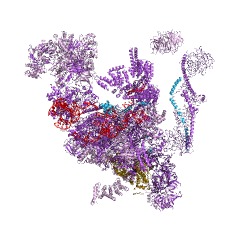
| 1th7 |  | Crystal structure of an archaeal sm protein from sulfolobus solfataricus |
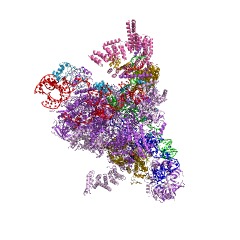
| 2fwk |  | Crystal structure of cryptosporidium parvum u6 snrna- associated sm-like protein lsm5 |
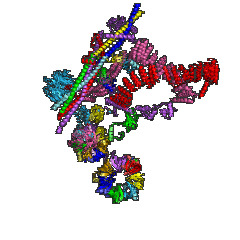
| 3bw1 |  | Crystal structure of homomeric yeast lsm3 exhibiting novel octameric ring organisation |
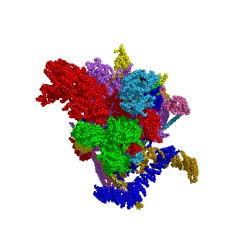
| 3cw1 |  | Crystal structure of human spliceosomal u1 snrnp |
- Links (links to other resources describing this domain)
-